

- Crypto derivatives trading volume is skyrocketing in 2025 as global participation rises and major exchanges expand their market share.
- The market is evolving from a retail-driven, high-leverage environment to a more institutional and strategically complex financial system.
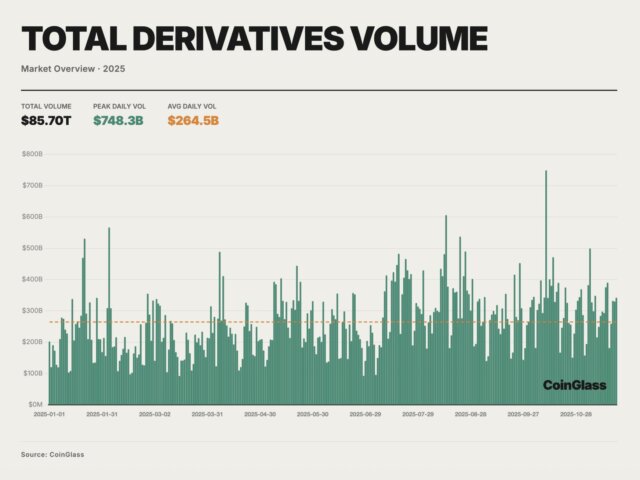
- The average daily derivatives trading surged to $264.5 billion, cementing crypto derivatives as a core component of global finance.
- Factors driving this growth include greater regulatory clarity, the rise of Bitcoin ETFs, increased institutional hedging, and enhanced exchange infrastructure.
The global cryptocurrency market crossed a historic threshold in 2025, as crypto derivatives trading volume climbed to an unprecedented $85.7 trillion, according to fresh data from CoinGlass. This milestone is more than just a headline number—it signals a deeper structural shift in how digital assets are traded, who is trading them, and how closely crypto markets are now intertwined with traditional finance.
What was once a fast-moving, retail-driven ecosystem dominated by high leverage and short-term speculation is steadily transforming into a more institutional, risk-managed, and strategically complex financial market. The sheer scale of activity in 2025, averaging $264.5 billion in daily derivatives trades, confirms that crypto derivatives are no longer a fringe product. Instead, they are becoming a core component of global financial infrastructure.
A Record-Breaking Year for Crypto Derivatives
The surge in crypto derivatives trading volume during 2025 reflects a market that has matured rapidly over a short period of time. Just a few years ago, derivatives were viewed as high-risk tools primarily used by retail traders chasing volatility. Today, they serve a much broader purpose. CoinGlass data shows that the derivatives market handled $85.7 trillion in total trades throughout the year, a figure that underscores crypto’s expanding role in global finance. On a daily basis, traders collectively moved more than $264 billion, placing crypto derivatives activity in the same conversation as major traditional asset classes. This growth did not happen in isolation. It was fueled by several converging factors:
- Greater regulatory clarity in key jurisdictions
- The rise of spot Bitcoin ETFs and regulated futures
- Increased institutional hedging activity
- More robust infrastructure across exchanges
Together, these developments created an environment where large financial institutions felt comfortable deploying capital at scale.
From Retail Speculation to Institutional Strategy
One of the most important stories behind the rise in crypto derivatives trading volume is the changing makeup of market participants. The era of dominance by small retail traders using extreme leverage is gradually fading. In its place, institutions are stepping in with a very different mindset. Rather than chasing short-term price swings, professional investors are using derivatives for:
- Risk hedging against spot holdings
- Basis trading between spot and futures markets
- Portfolio diversification
- Arbitrage strategies
- ETF-related exposure management
This shift was accelerated by the launch and growing adoption of spot crypto ETFs, which opened the door for pension funds, asset managers, and hedge funds to gain exposure through familiar and regulated vehicles. As a result, derivatives markets are now less about raw speculation and more about structured financial strategy. While volatility remains part of the crypto DNA, it is increasingly managed rather than blindly embraced.
Traditional Finance Tightens Its Grip on Crypto
Another striking development in 2025 was how closely crypto derivatives began to align with traditional financial institutions. A clear example is the Chicago Mercantile Exchange (CME), one of the world’s most influential derivatives marketplaces. In 2024, CME’s Bitcoin futures open interest surpassed that of Binance for the first time. That momentum carried forward into 2025, signaling growing trust in regulated venues over offshore platforms. This shift reflects a broader trend:
- Institutions prefer regulated futures
- Compliance and transparency matter more than ever
- Risk management systems are becoming standardized
CME’s rise is not about replacing crypto-native exchanges, but rather about expanding the ecosystem. Crypto derivatives are now traded across both decentralized, centralized, and traditional financial platforms—each serving a different purpose within a larger, interconnected market.
Binance Maintains Dominance in Centralized Markets
Despite the growing influence of traditional finance, Binance remained the undisputed leader among centralized crypto exchanges in 2025. According to CoinGlass:
- Binance recorded $25.09 trillion in total derivatives volume
- This represented 29.3% of the global market
- Nearly $30 out of every $100 in derivatives trades flowed through Binance
In terms of daily activity, Binance also led the market in open interest. The top ten centralized exchanges together averaged $108.3 billion in daily open interest, with Binance accounting for nearly $30 billion—around 28% of the total. This dominance highlights Binance’s continued relevance despite regulatory scrutiny and increasing competition. Its deep liquidity, broad product offerings, and global reach continue to attract both retail and institutional traders.
A More Complex and Fragile Market Structure
While the growth in crypto derivatives trading volume is impressive, it has also introduced new layers of complexity—and risk. Institutional strategies are far more intricate than simple long or short positions. Markets now rely heavily on:
- Multi-leg hedging strategies
- Cross-exchange arbitrage
- ETF inflow and outflow dynamics
- Automated liquidation systems
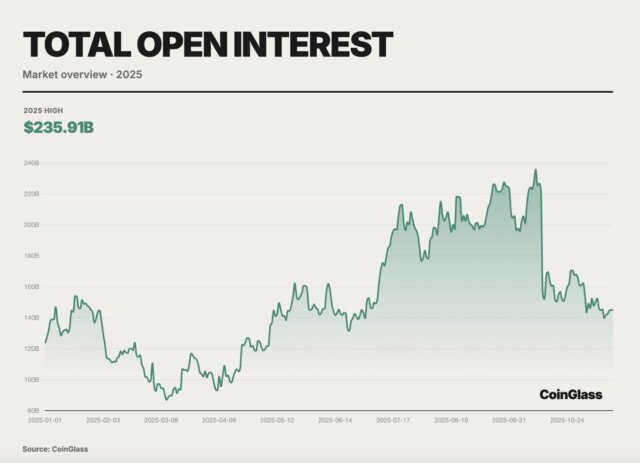
These elements can interact in unpredictable ways during periods of extreme volatility. In 2025, the market faced several stress tests. One of the most significant occurred in the fourth quarter, when a rapid deleveraging event erased approximately $70 billion in positions. The episode exposed vulnerabilities in liquidation mechanisms and highlighted how quickly risk can cascade across platforms. Yet, the market demonstrated resilience. By year-end, total open interest stood at $145.1 billion, marking a 17% increase from the beginning of the year. This recovery suggests that, while fragile, the system is learning how to absorb shocks more effectively.
Stablecoins Become the Backbone of Settlement
A major supporting pillar behind rising crypto derivatives trading volume is the explosive growth of stablecoins. In 2025:
- The total stablecoin market capitalization surpassed $230 billion
- On-chain settlement volume reached $1.5 trillion
Stablecoins have become essential for liquidity, collateral, and settlement across derivatives markets. Their appeal lies in their price stability, speed, and compatibility with both centralized and decentralized systems. Institutional adoption played a crucial role in this growth. Corporations, trading firms, and financial institutions increasingly used stablecoins for real-world transactions, treasury management, and cross-border settlements.
Regulation Fuels Confidence and Adoption
Regulatory progress, particularly in the United States, helped accelerate institutional confidence in stablecoins and digital assets. Legislation such as the GENIUS Act provided clearer guidelines around digital asset usage, custody, and compliance. Rather than stifling innovation, these frameworks offered a roadmap for responsible participation. With clearer rules in place:
- Companies felt safer integrating stablecoins into operations
- Financial institutions expanded crypto-related services
- On-chain settlement became more mainstream
This regulatory clarity also reinforced the legitimacy of crypto derivatives as a financial instrument rather than a speculative novelty.
Tokenized Assets Bridge Crypto and Traditional Markets
Beyond derivatives and stablecoins, 2025 marked a breakout year for tokenized real-world assets (RWAs). One of the most striking examples was tokenized stocks, which experienced a 2,695% surge in market value. These blockchain-based representations allow investors to gain exposure to traditional assets without leaving the crypto ecosystem. Tokenization offers several advantages:
- 24/7 trading
- Fractional ownership
- Reduced settlement times
- Increased global accessibility
As more assets—from equities to bonds to real estate—move on-chain, the boundaries between crypto and traditional finance continue to blur.
A Trillion-Dollar On-Chain Economy
Industry experts believe that tokenized assets could become one of the largest growth drivers in the coming decade. Some projections estimate that on-chain access to real-world assets could reach $18.9 trillion by 2033. This expansion would dramatically increase demand for derivatives used to hedge, speculate, and manage exposure to tokenized markets. In that sense, today’s surge in crypto derivatives trading volume may only be the beginning of a much larger transformation.
What to Expect in 2026 and Beyond
Looking ahead, several trends are likely to shape the next phase of the crypto derivatives market:
- Continued institutional adoption
- Greater regulatory harmonization across regions
- Expansion of DeFi-based derivatives
- Increased use of stablecoins for settlement
- More sophisticated risk management tools
Regulation will remain a double-edged sword. Clear and consistent rules can accelerate adoption, while uncertainty could temporarily slow growth. However, the direction is clear: crypto derivatives are moving closer to the core of global finance. Financial institutions are already experimenting with blockchain-based settlement, tokenization, and cross-border payment systems. As these experiments mature, derivatives will play a central role in managing the risks and opportunities that come with them.
The record-breaking crypto derivatives trading volume of $85.7 trillion in 2025 marks a defining moment for the digital asset industry. What was once considered a speculative playground has evolved into a sophisticated, institutionally driven market that mirrors—and increasingly integrates with—traditional finance. From Binance’s continued dominance in centralized trading to CME’s growing influence, from the rise of stablecoins to the explosion of tokenized assets, every signal points toward deeper adoption and structural maturity. While challenges remain, particularly around risk management and regulation, the market has shown resilience in the face of extreme stress. As crypto derivatives continue to evolve, they are no longer operating on the fringes. Instead, they are becoming a foundational layer of the modern financial system—larger, more connected, and more influential than ever before.
Disclaimer: CryptopianNews shares this for learning and info only. It’s not meant to be financial or investment advice. Crypto markets change a lot and move quickly. Investing in them can be risky. You should always look into things yourself. Talk to a trained financial advisor before making any choices about investing.

- Tensor Coin (TNSR) Update: 216M Burn, Supply and 2026 Developments - October 3, 2026
- BTC stuck in a range: Large Buyers Signal Strength - July 20, 2026
- CLARITY Act Odds Drop to 35% After DOJ Warning - July 18, 2026