

Key Takeaways
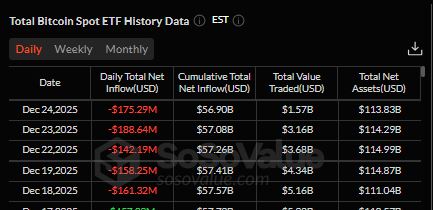
- US spot Bitcoin ETFs recorded $825 million in net outflows over five trading days, led by institutional selling.
- Selling pressure appears strongest during US trading hours, based on session-based return data.
- Asian markets continue to accumulate Bitcoin on spot exchanges during the same period.
- These trends highlight clear regional differences in bitcoin trading patterns.
- Market structure, regulation, and investor behavior drive this divergence.
US Bitcoin ETF Outflows Signal Structural Selling
Recent data explains why is the us selling bitcoin despite stable long-term fundamentals. According to SoSovalue, US spot Bitcoin ETFs lost over $825 million within five consecutive trading sessions. This marked the largest short-term capital exit since ETF approval.
The selling was concentrated among institutional funds. BlackRock’s IBIT and Fidelity’s FBTC both recorded sustained withdrawals. These flows occurred during thin holiday liquidity, which intensified their market impact.
However, this activity does not reflect retail panic. Instead, it highlights strategic institutional behavior. Many US investors rebalance portfolios before year-end for tax efficiency. As a result, Bitcoin exposure often becomes a liquidity source.
Institutional Incentives Drive Short-Term Selling
US institutions frequently use ETFs as tactical instruments. When volatility increases, exposure is adjusted rapidly. Therefore, Bitcoin ETFs amplify capital movement more than spot markets.
Additionally, regulatory clarity in the US encourages compliance-driven behavior. Funds often reduce risk before reporting periods. Consequently, Bitcoin becomes vulnerable to timing-based selling rather than sentiment-based exits.
This structural factor explains why US selling pressure does not always reflect broader bearish conviction.
Bitcoin US vs Asia Market Dynamics During Trading Sessions
The bitcoin us vs asia market dynamics become clearer when analyzing trading hours. Market data shows Bitcoin prices often weaken during US sessions. Meanwhile, prices stabilize or rise during Asian hours.
This pattern suggests different decision frameworks. US traders tend to react to macro signals. Asian traders respond more strongly to spot price opportunities.
Coinbase Premium data reinforces this divergence. A negative premium indicates weaker demand from US buyers compared to offshore markets. Recently, this indicator remained negative for several sessions.
Time Zones and Liquidity Behavior
Asian trading sessions benefit from continuous liquidity. Many regional exchanges operate with stablecoin pairs, which lowers friction. As a result, accumulation becomes easier during dips.
US markets rely more heavily on regulated products. ETFs trade during fixed hours, which concentrates flows. Therefore, selling pressure appears sharper during US sessions.
These mechanics directly influence short-term price movements.
Regional Differences in Bitcoin Trading Patterns
Clear regional differences in bitcoin trading patterns explain the current divergence. US investors often prioritize compliance and capital efficiency. Asian investors focus more on spot ownership and long-term exposure.
Retail participation remains higher in many Asian markets. When prices decline, dip-buying behavior becomes dominant. This contrasts with US institutional desks, which often reduce exposure during uncertainty.
Exchange Preferences and Market Structure
Asian traders frequently use centralized spot exchanges. These platforms offer deep liquidity and stablecoin settlement. This structure supports incremental accumulation.
In contrast, US exposure concentrates within ETFs. When redemptions occur, actual Bitcoin supply increases on the market. This creates visible selling pressure.
Thus, structural design shapes behavior more than sentiment alone.
Macro Conditions and Risk Perception
Macroeconomic uncertainty also contributes to US selling. Interest rate expectations and dollar strength influence institutional strategies. When yields remain elevated, risk assets face rotation pressure.
Asian markets interpret macro signals differently. Many investors view Bitcoin as a hedge against currency debasement. Consequently, accumulation increases during Western sell-offs.
This divergence reinforces asymmetric demand across regions.
Market Signals Suggest Rotation, Not Capitulation
Despite selling pressure, on-chain data does not show widespread capitulation. Long-term holders continue to maintain positions. Exchange balances remain relatively stable.
ETF outflows reflect capital rotation, not loss of confidence. Meanwhile, Asian spot demand absorbs excess supply during off-hours.
This interaction stabilizes price action and reduces downside momentum.
Why Regional Behavior Matters for Price Discovery
Bitcoin trades globally but reacts locally. Each region contributes differently to price discovery. US markets influence volatility, while Asia often provides stability.
Understanding why is the us selling bitcoin requires examining these interactions rather than isolated metrics. When US sellers dominate, Asian buyers frequently counterbalance supply.
This tug-of-war defines short-term Bitcoin behavior.
Read Also: Bitcoin All-Time High 2026: Why Experts Say the Market Cycle Has Changed
Disclaimer!! The information provided by CryptopianNews is for educational and informational purposes only. It should not be considered financial or investment advice. Cryptocurrency markets are highly volatile and speculative, and investing in them carries inherent risks. Readers are advised to conduct their own research and consult with a qualified financial advisor before making any investment decisions.

- The potential of AI Agents as the next big user base for cryptocurrencies. - October 3, 2026
- Bitcoin ETFs Bring $2.65B in September as Institutional Demand Returns - October 2, 2026
- With $388M hacked, Bitget resumes Bitcoin Withdrawals After Stolen Crypto Moves. - September 28, 2026