
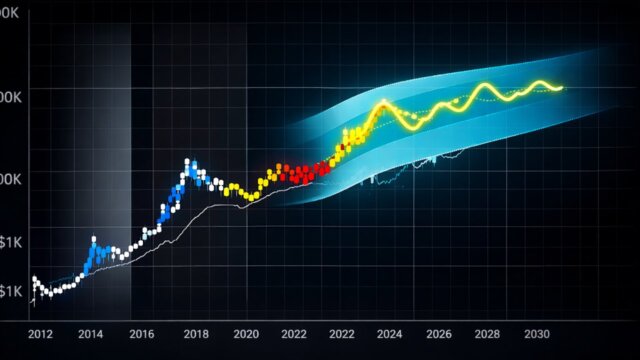
- The planb bitcoin Stock-to-Flow model forecasts Bitcoin averaging $500K between 2024–2028.
- The model highlights Bitcoin scarcity after the 2024 halving as a key driver of long-term price growth.
- According to the latest outlook, current price levels around $67,000 may represent a favorable buying zone.
- Historical predictions from the S2F framework previously pointed to major Bitcoin milestones.
- However, investors should remember that volatility and uncertainty remain part of the crypto market.
Bitcoin has always been known for its dramatic price swings and bold predictions. Recently, crypto analyst PlanB once again sparked debate with an updated outlook suggesting that Bitcoin could average $500,000 per coin during the current market cycle. This forecast comes from the well-known Stock-to-Flow (S2F) model, which focuses on scarcity as the primary factor influencing Bitcoin’s value. The planb bitcoin perspective argues that the market may still be in the early stages of the cycle despite Bitcoin trading around $67,000. According to the model, historical patterns show that Bitcoin tends to experience its biggest growth phases after each halving event. Because the 2024 halving reduced the rate of new Bitcoin entering circulation, the model predicts a sharp increase in long-term value. While the prediction is exciting, investors are divided. Some believe the model highlights the powerful effect of supply reduction, while others argue it ignores market demand and external factors. Still, the discussion around Bitcoin’s potential continues to grow as the new cycle unfolds.
Understanding the PlanB Bitcoin Stock-to-Flow Model
The planb bitcoin model is based on the economic principle of scarcity. In simple terms, the Stock-to-Flow ratio compares the existing supply of an asset (stock) to the amount produced each year (flow). Assets with high scarcity, such as gold, typically have higher valuations because they are difficult to produce. Bitcoin fits well into this framework because its supply is limited to 21 million coins. Additionally, the mining reward is cut in half roughly every four years through an event known as the halving. As a result, the flow of new Bitcoin entering the market decreases over time. Because of this mechanism, the Stock-to-Flow model predicts that Bitcoin should become more valuable after each halving cycle. Historically, large price increases have followed these events. Therefore, supporters of the model see it as a useful long-term indicator rather than a short-term trading tool.
Why the Model Points Toward a $500,000 Average Price
One of the most striking aspects of the updated forecast is the possibility of a $500,000 average price during the 2024–2028 cycle. This number may sound extreme at first. However, the model suggests that Bitcoin’s scarcity is rapidly increasing as fewer coins are mined each year. After the 2024 halving, the block reward dropped again, significantly lowering the rate of new supply. When supply growth slows while demand remains steady or increases, prices tend to rise. That basic economic principle is the foundation of the Stock-to-Flow approach. According to the updated chart, the model’s trend line jumps sharply after the latest halving. This shift points to a much higher valuation range compared to previous cycles. While the market will not move in a straight line, the average price across the cycle could approach the half-million-dollar mark if the pattern continues.
Historical Accuracy and Previous Predictions
Supporters often point to the model’s earlier forecasts as evidence of its usefulness. PlanB famously started accumulating Bitcoin around $400 in 2015, long before the cryptocurrency gained mainstream attention. At the time, many investors dismissed the idea that Bitcoin could become a major financial asset. Later, when Bitcoin traded below $4,000 in 2019, the model suggested a potential rise toward $55,000. That prediction attracted significant attention once Bitcoin eventually surpassed the level during the 2021 bull run. These past projections helped build credibility for the framework. However, critics argue that some predictions also missed exact price targets. Therefore, they caution investors not to rely solely on a single model when making financial decisions.
Why Some Analysts Still Criticize the Model
Despite its popularity, the Stock-to-Flow model has faced strong criticism within the crypto community. The main argument is that it focuses almost entirely on supply while largely ignoring demand factors. In real markets, price is determined by both. For example, global economic conditions, institutional adoption, regulations, and investor sentiment all influence Bitcoin’s value. These factors can cause significant price movements that the model does not directly account for. Furthermore, as Bitcoin matures, market behavior may change. Early cycles were driven mainly by retail speculation, whereas newer cycles involve institutional investors and global financial trends. Because of this shift, some analysts believe the model may become less accurate over time. Still, many long-term Bitcoin supporters view it as a useful framework for understanding scarcity and macro trends rather than a precise price prediction tool.
Is the Current Market an Ultimate Buying Opportunity?
Supporters of the model believe the current market phase may present a strong accumulation opportunity. Based on the latest chart indicators, Bitcoin’s Relative Strength Index (RSI) suggests the market is not overheated yet. Historically, the early stages after a halving have often been quiet before explosive growth begins. During these periods, Bitcoin tends to trade within a range while investors slowly accumulate coins. However, it is important to remember that Bitcoin has always been volatile. Previous bull markets included large corrections of 30–50% even during strong upward trends. Because of this, investors should prepare for sharp fluctuations along the way.
Conclusion
The updated outlook from the Stock-to-Flow framework has once again ignited debate across the crypto community. According to the model, Bitcoin’s increasing scarcity following the 2024 halving could push the average cycle price toward $500,000 per BTC. Supporters believe the supply reduction mechanism makes Bitcoin fundamentally stronger over time. Meanwhile, critics warn that no model can fully predict market behavior, especially in a rapidly evolving financial environment. Ultimately, the planb bitcoin outlook should be viewed as one perspective rather than a guaranteed outcome. Bitcoin’s future will depend on multiple factors, including adoption, regulation, and global economic trends. Still, the possibility of massive long-term growth continues to attract investors and keep the conversation alive.
Disclaimer: CryptopianNews shares this for learning and info only. It’s not meant to be financial or investment advice. Crypto markets change a lot and move quickly. Investing in them can be risky. You should always look into things yourself. Talk to a trained financial advisor before making any choices about investing.

- Bitcoin tightest session: Why Traders Are Watching $65K - July 20, 2026
- Can 5x Bitcoin Still Happen This Market Cycle? - July 18, 2026
- Capital Is Chasing AI: Why Bitcoin Is Waiting Its Turn - July 2, 2026