
Choose a section or paragraph
The next major development in Web3 may not come from another cryptocurrency launch. It could come from the traditional financial industry.
Banks, asset managers and governments are increasingly exploring blockchain technology to represent financial assets as digital tokens. The process, known as tokenization, is attracting attention because it could change how securities, investment funds, bonds and other assets are issued, transferred and settled.
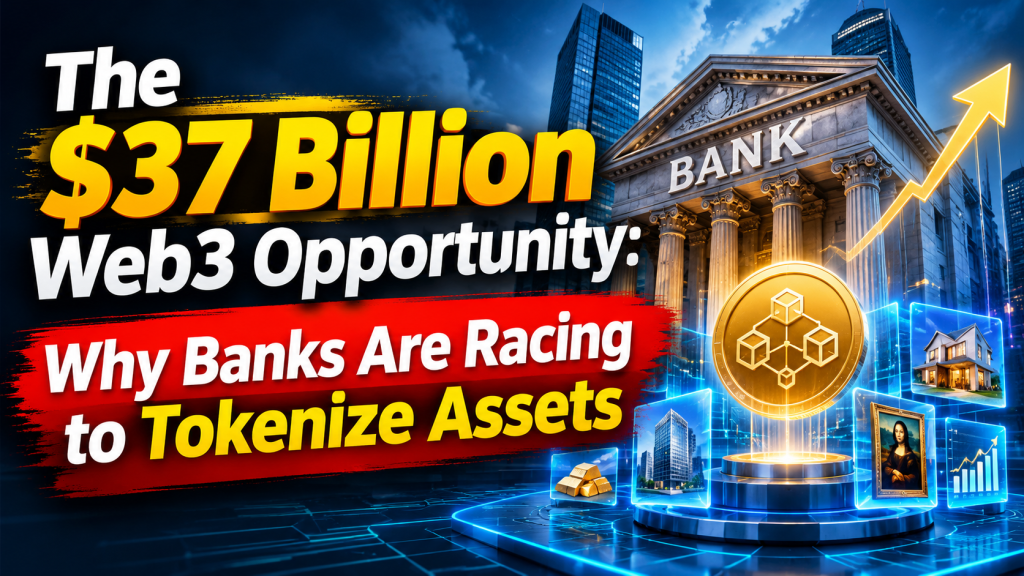
The market is already showing measurable progress. A November 2026 report from the International Organization of Securities Commissions (IOSCO) found that the tokenized real-world asset market increased from approximately $16 billion in July 2025 to $37 billion by June 30, 2026.
This growth has strengthened interest in blockchain-based financial infrastructure. However, the industry still faces important challenges involving regulation, investor protection, liquidity and compatibility between different networks.
The next stage of Web3 adoption may depend on whether financial institutions can solve these problems.
Tokenized Real-World Assets Reach Approximately $37 Billion
Real-world asset tokenization involves representing ownership rights or financial interests through digital tokens recorded on blockchain networks.
These assets can include government bonds, investment funds, private credit, commodities and certain forms of equity.
Instead of relying entirely on traditional financial databases and settlement systems, tokenization allows some ownership and transaction records to be maintained using distributed ledger technology.
The potential benefits include faster settlement, improved recordkeeping and the possibility of making certain financial products accessible through digital platforms.
IOSCO’s November 2026 monitoring report provides an important indication of how quickly the sector has developed.
The organization reported that the tokenized RWA market grew from around $16 billion on July 1, 2025, to approximately $37 billion on June 30, 2026.
This represents significant growth, although the market remains small compared with traditional global financial markets.
It is also important to understand that the $37 billion figure describes the monitored tokenized RWA market, not the entire cryptocurrency market or the value of all financial assets that could eventually move onto blockchains.
Nevertheless, the figures demonstrate that tokenization is moving beyond experimental projects and becoming a more established area of financial technology.
Why Traditional Banks Are Interested in Blockchain Tokenization
Traditional financial institutions have several reasons to explore tokenization.
One major motivation is settlement efficiency.
Conventional financial transactions often involve multiple intermediaries, separate databases and different processing schedules. Depending on the asset and market, settlement can take time because the parties involved need to verify transactions and ownership through different systems.
Blockchain technology offers another approach.
A shared digital ledger can record transactions and ownership changes in a coordinated environment. Smart contracts can also automate certain operations when predefined conditions are met.
This does not mean every blockchain transaction is automatically faster or cheaper than a traditional financial transaction. Network congestion, compliance checks, custody arrangements and legal requirements still matter.
However, institutions see potential in combining programmable financial assets with more efficient settlement infrastructure.
Tokenized bonds and money market funds are particularly relevant because they can connect blockchain-based records with existing financial products.
For banks, the opportunity is not necessarily to replace the traditional financial system. It is to improve parts of that system using new technology.
Europe Is Building a New Framework for Tokenized Financial Markets
Europe has become an important part of the tokenization discussion.
On November 5, 2026, European Central Bank President Christine Lagarde discussed the need for an integrated tokenized financial ecosystem.
The ECB’s work includes two important initiatives: Pontes and Appia.
Pontes focuses on providing a settlement connection between tokenized financial assets and central bank money.
Appia is designed to examine the architecture, standards and governance required for a broader European tokenized financial ecosystem.
The ECB has stated that its objective is to deliver a blueprint for this ecosystem in 2028.
The central concern is fragmentation.
If different financial institutions create separate blockchain platforms that cannot communicate with one another, the result could be a collection of isolated digital markets.
Assets might exist on different networks without a straightforward way to transfer liquidity or ownership between them.
This would limit one of the major promises of tokenization.
Europe’s approach therefore places significant attention on shared standards, interoperability and the legal framework surrounding digital assets.
Hong Kong Expands Its Digital Asset Regulatory Framework
Europe is not the only financial centre working to develop its digital asset infrastructure.
Hong Kong published its Virtual Asset Services Legislation (Amendment) Bill 2026 on November 20.
The proposed legislation seeks to expand regulatory requirements to cover additional virtual asset services, including dealing, advisory, management and custody activities.
Under the proposal, businesses providing these services in Hong Kong would generally need to obtain the relevant licence or registration from the Securities and Futures Commission.
The proposed framework also addresses financial institutions, including banks and stored value facility licensees that want to provide virtual asset services.
This is an important development because the digital asset industry needs more than trading platforms.
Custody providers, investment advisers, asset managers and other service companies are becoming increasingly important as financial institutions explore tokenized assets.
Clearer licensing requirements could help establish a more structured environment for these activities.
However, regulatory expansion also creates new compliance responsibilities. Smaller Web3 companies may need additional resources to meet licensing, reporting and operational requirements.
The bill is scheduled for its first reading in Hong Kong’s Legislative Council on December 2, 2026. It should therefore be described as a legislative proposal rather than an already implemented licensing regime.
Interoperability Could Become the Biggest Web3 Infrastructure Challenge
The expansion of tokenized financial markets creates a problem that blockchain developers have been trying to solve for years.
Different networks do not automatically communicate with one another.
A tokenized bond issued on one blockchain may not be directly compatible with a financial application operating on another network.
The same problem can affect asset transfers, liquidity management and settlement processes.
Interoperability aims to connect these separate systems.
It involves technologies and standards that allow information and assets to move between networks while maintaining appropriate security and verification.
For institutional investors, interoperability is particularly important because they may not want to depend on a single blockchain provider.
They need systems that can connect with existing financial infrastructure and comply with operational requirements.
This creates opportunities for Web3 infrastructure projects working on cross-chain communication, secure data services, settlement systems and digital asset custody.
However, interoperability also introduces risks. Poorly designed bridges and cross-chain applications have experienced security failures in the past.
Financial institutions will require strong security controls before allowing significant amounts of institutional capital to move between networks.
Tokenization Is Growing, but Adoption Still Has Limits
The growth of the tokenized RWA market should not be confused with the arrival of a fully developed global tokenized financial system.
IOSCO’s November report identifies several issues that continue to affect the sector.
One concern involves the legal rights attached to tokenized assets.
A digital token does not automatically provide the same legal ownership rights as a conventional financial security. Its rights depend on the legal structure, issuing arrangement and applicable regulations.
Another challenge involves liquidity.
A tokenized asset may be technically transferable but still have limited buyers and sellers. Without sufficient market participation, investors may find it difficult to trade the asset at a fair price.
Custody is also important.
Financial institutions need reliable systems to protect digital assets and manage private keys. A security failure could create serious operational and financial consequences.
IOSCO also highlights the role of existing intermediaries. Tokenization does not necessarily remove custodians, brokers, transfer agents or market makers from financial markets.
In many cases, these institutions remain important parts of the process.
The transition is therefore more likely to involve integrating blockchain into established financial infrastructure than replacing the entire system.
Which Web3 Sectors Could Benefit From the Tokenization Race?
The growing interest in tokenized assets could create opportunities across several areas of the Web3 industry.
Infrastructure providers may benefit from demand for secure blockchain networks and institutional settlement systems.
Oracle providers could become more important because tokenized financial applications often require reliable external information, including asset valuations and financial data.
Custody companies may also gain relevance as banks and asset managers seek institutional-grade digital asset protection.
Cross-chain technology could attract additional attention if financial institutions need to move assets and information between different blockchain environments.
Stablecoins are another important part of this development. They can provide digital representations of fiat currency and support settlement activity within blockchain-based financial applications.
However, not every project operating in these sectors will benefit equally. Technology quality, regulatory compliance, security and real customer demand will determine which businesses can establish long-term positions.
Readers interested in the wider sector can explore our Web3 and blockchain coverage.
Is Tokenization the Next Major Phase of Web3 Adoption?
Tokenization is becoming one of the most important areas of development in the digital asset industry.
The latest IOSCO figures show meaningful growth, while the ECB’s Appia and Pontes initiatives demonstrate that public institutions are also working on the infrastructure required to support tokenized financial markets.
Hong Kong’s proposed expansion of virtual asset regulation adds another important dimension by addressing the companies that will provide services around digital assets.
These developments suggest that the next stage of Web3 adoption could involve closer cooperation between traditional financial institutions and blockchain technology providers.
However, the industry still needs to address fragmented networks, legal uncertainty, custody risks and limited liquidity.
The $37 billion market provides evidence of progress, not proof that tokenization will replace traditional finance.
The companies that build secure infrastructure, establish regulatory compliance and connect different financial systems could become important players in this developing market.
For Web3, the real opportunity may not be creating another token. It may be making blockchain technology useful to the financial system that already exists.
Web3 Infrastructure and TRON’s Quantum-Ready Future

- The $37 Billion Web3 Opportunity: Why Banks and Governments Are Racing to Tokenize Real-World Assets - November 22, 2026
- BlackRock’s BUIDL Gets $100 Million Liquidity Facility: Can Investors Now Move Between Tokenized Assets and Stablecoins 24/7? - November 15, 2026
- Bitcoin ETF Outflows Continue as Crypto Market Fear Grows: What Investors Should Watch Next - November 12, 2026