
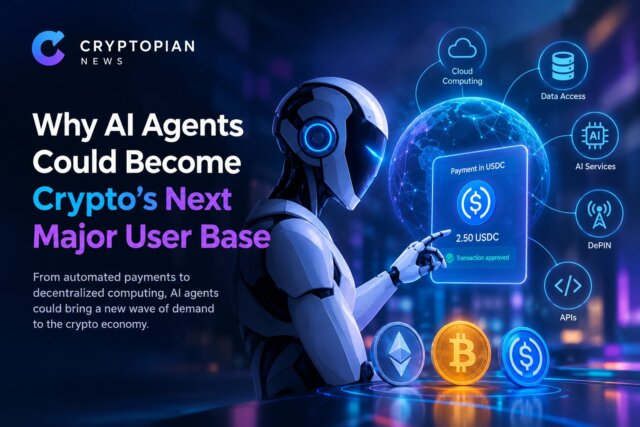
Artificial Intelligence agents aren’t just chatbots and automated assistants anymore. New systems can be capable of completing tasks, engaging with digital services, managing workflows or interfacing with different software with minimum human oversight. As these capabilities continue to grow, crypto infrastructure can offer some of the tools with which they can be independent.
One such area that’s catching the spotlight is payments between machines. An AI agent might require to pay for computing capacity, buy data, or utilize an API or other digital services. The traditional payment systems may not be very convenient for automated transactions, especially for small payments or trans-border transactions.
An alternative is blockchains and stablecoins. They enable software to communicate with the payment systems via programmable systems that could present a market opportunity for crypto projects that develop services for AI agents.
The necessity of Crypto Infrastructure for AI Agents.
The majority of online payments cater for people and businesses. They may involve accounts, identity verification, or payment cards or approval processes that hinder automated transactions.
AI agents function in a different manner. They might have to make payments often, buy services from several vendors, and make it without having to wait for someone to approve it every time.
This can be facilitated using software based wallets and programmable transactions on the blockchain. Stablecoins offer a digital payment option that will give a value pegged to a conventional currency, eliminating the need to constantly deal with volatile assets for day-to-day purchases.
But those systems must be protected. B2B wallet security, transaction limits, permission and the potential of an agent making a wrong payment are all factors developers need to take into account.
If you are a crypto business, the chance is not restricted to making an altogether different token. It also involves the creation of infrastructure to provide automated software with access to financial and digital services.
Stablecoins have the potential to serve as a means of payment for AI.
Stablecoins, which are typically built to track the value of a fiat currency, such as the US dollar, are natural favorites when it comes to AI payments.
For instance, if the AI agent is buying computing resources, it might have to make multiple small payments during a task. A stablecoin also offers a much more predictable price than a cryptocurrency that is fluctuating on a regular basis.
Blockchain’s payments can also work outside the traditional banking hours. Process times could be in seconds or minutes, depending on the network and service provider.
Not all AI agents require cryptocurrencies. There are some businesses that will continue to go with more traditional payment providers – particularly, if customer protections, refunds and existing accounting procedures are important rather than automation.
It’s more than just independent trading for the potential market. Ultimately, AI agents might be able to spend money to book cloud computing services, acquire expert data sets, pay software tools or reward other agents to accomplish tasks.
There are several different stablecoin issuers, crypto payment providers and wallet developers who could be vying to meet this demand.
Which Crypto Sectors Could Benefit From?
AI agents have the potential to shape various aspects of the crypto sector.
Blockchain networks: AI agents require networks that are capable of facilitating transactions at reasonable prices. If the payments are too expensive or the confirmation takes too long, it would be difficult to make payments on a regular basis using the automated system. Marketers will be required to perform reliably, for networks looking to be a player in this space.
Agent infrastructure: Agents need a repository to store assets and a mechanism to make payments. Developers are experimenting with programmable wallets and delegated permissions and account-abstraction enabling tools that can constrain an automated system.
Decentralized physical infrastructure networks (DePIN): These projects combine blockchain technology with physical infrastructure like computing power, storage capacity and wireless connectivity. Such networks could be used by AI developers to access resources, but the service quality, costs and reliability of the provider are all factors to consider.
Decentralized finance: DeFi protocols could provide automated access to liquidity and other financial services. But, there are other risks with autonomous access – smart contract issues, market fluctuations and unintended transactions.
Authentication and authorization: AI agents might have to verify their identity to access a service, while avoiding revealing any superfluous information. These requirements can be fulfilled by using some of the existing crypto based credentials and verification systems.
These are linked but the commercial opportunities will depend on actual demand, technical performance and attractiveness to paying users.
Crypto Projects Are Paying Attention For These Reasons
AI agents could produce a distinctive source of blockchain activity, aside from trading and investment activity, which currently dominates the crypto market.
Clearly, this is just one example of how you could use a network to not only send tokens, but sign up for a service when you need it.
Let’s say you have an AI agent creating a market research report. It may buy a data set, pay for computing time and use a number of specialist services. Each provider may allow an automated payment, in which case the agent could do this job with minimal human involvement.
This does not demonstrate that this model is widespread yet. That’s an example of how developers want the workflow to work.
The problem for blockchain projects is to make these use cases repeatable economic activity. While the AI story can be compelling, the applications need to be of actual value to users and willing to pay for them for the network to gain traction.
Crypto firms with high-quality documentation, robust infrastructure, and user-friendly developer tools might better be equipped to attract builders in this market. Other partnerships with an AI platform and payment providers can also help projects to reach customers outside of the crypto world.
The Problems that May Hamper Adoption.
For now however, there are several hurdles for AI agents to overcome before they can be a major driver of crypto demand.
One of the biggest concerns is security. An agent managing a wallet could end up emptying the account if it became misled or mistook to obey bad instructions, or if it was taken over by a compromised software, or if it made a wrong decision. Spending restrictions, permission controls and revocation mechanisms are needed by Developers.
Transaction costs also play a role. When network fees are a big part of the sum that is being moved, small payments become impractical. Other scaling systems such as layer 2 networks could assist, but users require reliable settlement & adequate liquidity.
The other challenge is regulation. The requirements for payments services and financial transactions and identity vary from jurisdiction to jurisdiction. Whenever there are AI agents deployed, businesses must decide on the applicability of rules to their products and business operations.
The demand question is also raised. When it comes to automation and payments, it’s beneficial to have if and only if it brings a service ease, saving money, efficiency or anything else. Numerous AI products can still be sold via traditional subscription plans and centralized payment mechanisms.
Crypto infrastructure needs to provide some sort of value versus adding a blockchain transaction onto an existing process.
This implies certain outcomes for the crypto market in 2027.
The future potential of AI-agents may generate fresh opportunities for the crypto infrastructure space, especially in stablecoin payments, programmable wallets, decentralized computing and identity services.
What will be critical is actual usage. The developers and investors should keep an eye out for the growth of payments associated with identifiable applications, recurring demand for infrastructure and partnerships that result in measurable activity.
The price of tokens won’t be the only way to determine if the segment is gaining adoption. Nor will AI integration announcements be an immediate cash flow or a long-term user base.
It gives crypto businesses a motivation to concentrate on the product. In the future, as AI systems become more capable, projects addressing payment, security or infrastructure issues could offer commercial opportunities.
AI agents will not necessarily bring cryptocurrency into being an integral part of the internet. Traditional payment service providers and the centralized options will continue to compete against each other. If, however, software has more frequent and autonomous transactions with digital services, then blockchain networks can form part of the financial infrastructure that facilitates those transactions.
The challenge for the crypto industry is to make that process secure, cheap and productive enough to be adopted by d
evelopers and businesses.
Tensor Coin (TNSR) Update: 216M Burn, Supply, and 2026 Developments
Bitcoin ETFs Bring $2.65B in September as Institutional Demand Returns
CryptopianNews provides this information for educational and informational purposes only. You should not consider it financial or investment advice. Cryptocurrency markets are highly volatile and speculative, and they carry inherent risks. We advise readers to conduct their own research and to consult with a qualified financial advisor before making any investment decisions.

- The potential of AI Agents as the next big user base for cryptocurrencies. - October 3, 2026
- Bitcoin ETFs Bring $2.65B in September as Institutional Demand Returns - October 2, 2026
- With $388M hacked, Bitget resumes Bitcoin Withdrawals After Stolen Crypto Moves. - September 28, 2026