
Choose a section or paragraph
Important points
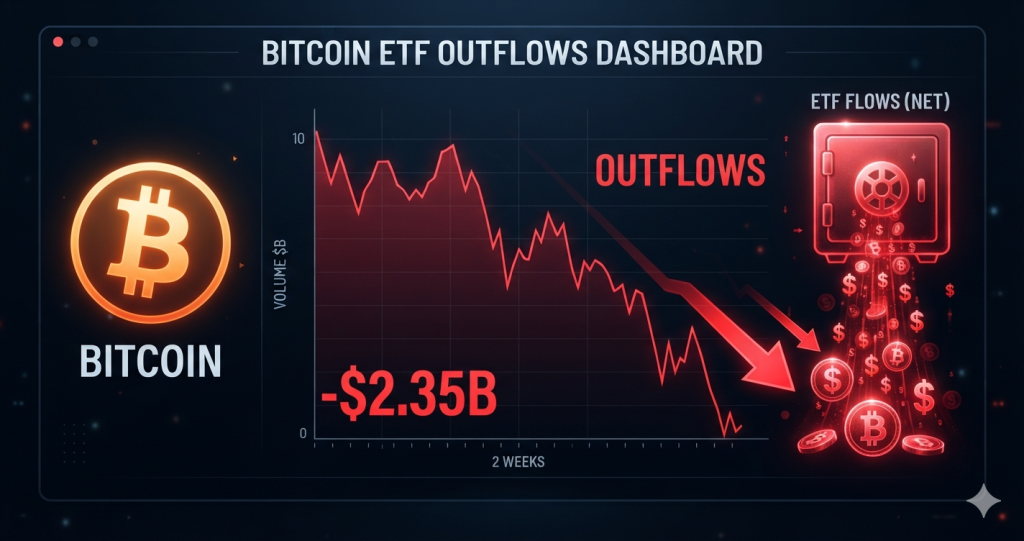
- US spot Bitcoin ETFs recorded approximately $2.35 billion in net outflows across the first two completed November trading weeks.
- The funds lost $1.28 billion during the previous week and another $1.07 billion between November 9 and November 13.
- BlackRock’s IBIT recorded withdrawals for 11 consecutive trading sessions.
- Bitcoin dropped to approximately $62,080 on November 15, its weakest level since July.
- Extreme market fear, weaker institutional demand, and broader cryptocurrency selling intensified market pressure.
The US spot Bitcoin ETF market is experiencing one of its most significant withdrawal periods in recent months. Investors have withdrawn approximately $2.35 billion over two consecutive weeks, raising concerns about institutional demand and Bitcoin’s short-term price direction.
According to Farside Investors data, spot Bitcoin ETFs recorded $1.28 billion in net outflows during the first week. Furthermore, another $1.07 billion left these investment products between November 9 and November 13.
Consequently, the withdrawals represented the largest two-week outflow period since June, when approximately $3.14 billion left these funds.
The selling continued throughout the latest trading week. On November 9, Bitcoin ETFs experienced withdrawals, followed by additional losses across the remaining four sessions.
Friday’s trading session alone recorded approximately $185.4 million in net outflows. BlackRock’s IBIT contributed $143.5 million, while Fidelity’s FBTC recorded another $41.9 million.
Meanwhile, Bitcoin’s market performance deteriorated considerably. CoinGecko data showed BTC reaching an intraday low of $62,080.91 . Although the cryptocurrency recovered above $65,000, it remained approximately 15% lower over seven days.
The broader market also weakened. Ether declined 19.5% weekly, while Solana lost approximately 20.7%. Additionally, the global cryptocurrency market capitalization dropped 4% to $2.26 trillion within 24 hours.
These developments suggest that ETF withdrawals are occurring alongside broader market weakness rather than in isolation.
BlackRock IBIT outflows streak signals institutional caution
BlackRock’s iShares Bitcoin Trust has become a major contributor to the latest withdrawal cycle. Its prolonged redemption streak has attracted attention because IBIT remains one of the largest spot Bitcoin investment products.
The blackrock ibit outflows streak reached 11 consecutive trading sessions on November 14, extending a negative trend that started on October 30.
According to the reported fund-flow figures, IBIT lost approximately $908.4 million during the week ending November 13. The previous week brought another $1.21 billion in withdrawals.
As a result, its November outflows reached approximately $2.12 billion, representing roughly 90% of the industry’s net Bitcoin ETF withdrawals during the month.
This concentration deserves attention. When a leading ETF experiences persistent redemptions, investors may interpret the development as weakening institutional appetite for Bitcoin exposure.
However, ETF withdrawals do not automatically mean BlackRock itself has become bearish on Bitcoin. Investors purchase and redeem shares, while the fund manages its underlying Bitcoin holdings according to its structure.
Furthermore, institutional investors can reduce ETF exposure for several reasons, including portfolio rebalancing, profit protection, liquidity requirements, and changing risk assessments.
Therefore, IBIT’s performance provides an important indication of investor positioning, but it does not independently establish the direction of long-term institutional sentiment.
Do ETF outflows affect Bitcoin price? Understanding the market connection
Bitcoin ETFs influence market demand because authorized participants and fund mechanisms connect investor share activity with the underlying Bitcoin market.
When investors redeem ETF shares, the funds may need to sell Bitcoin or use cash and redemption mechanisms to meet those requests. Consequently, sustained redemptions can reduce demand and potentially introduce additional selling pressure.
However, the relationship between ETF flows and Bitcoin prices is not always immediate or proportional.
For example, Bitcoin can decline even when ETFs record inflows because other market participants may sell larger quantities. Similarly, positive ETF flows cannot guarantee price appreciation during periods of substantial derivatives liquidations.
The latest November figures illustrate this relationship. ETF withdrawals coincided with Bitcoin’s decline below $70,000 and its subsequent four-month low near $62,000.
Nevertheless, broader market conditions also contributed to the decline.
Investors facing uncertainty may reduce exposure to volatile assets. Meanwhile, leveraged traders can experience liquidations when Bitcoin breaks important technical support levels, accelerating downward price movements.
What investors should monitor next
The next few trading sessions could provide important information about whether institutional demand is stabilizing or weakening further.
First, investors should monitor daily ETF net flows. A return to consistent inflows would indicate improving demand, particularly if BlackRock and Fidelity begin attracting capital again.
Second, Bitcoin’s spot-market trading volume deserves attention. Strong buying activity during price recoveries could indicate that investors are accumulating rather than simply waiting for lower prices.
Third, derivatives-market positioning can reveal whether excessive leverage is contributing to volatility. Rising liquidations and negative funding conditions could increase short-term downside risks.
Bitcoin’s next move depends on more than ETF flows
The Crypto Fear & Greed Index reached 10, placing market sentiment firmly in extreme fear territory. This deterioration highlights the importance of monitoring investor confidence alongside institutional flows.
If ETF withdrawals continue while Bitcoin struggles to reclaim important price levels, additional selling pressure could emerge. Conversely, slowing redemptions and improving spot demand could support a recovery.
For now, investors should avoid treating one indicator as a complete market signal. ETF flows, liquidity conditions, derivatives positioning, and broader economic developments collectively provide a more reliable picture of Bitcoin’s market direction.
Disclaimer: Cryptocurrency markets are highly volatile. This article is for informational purposes and is not financial advice.

- Bitcoin ETF Outflows Explained: Why $2.35B Left in 2 Weeks - November 15, 2026
- Bitcoin ETFs Lose $1.07 Billion in One Week as BTC Slides Toward $65,000: Is More Selling Ahead? - November 15, 2026
- PNC Bank and Coinbase Bring USDC Payments to Traditional Banking: Is Crypto Going Mainstream? - November 10, 2026