
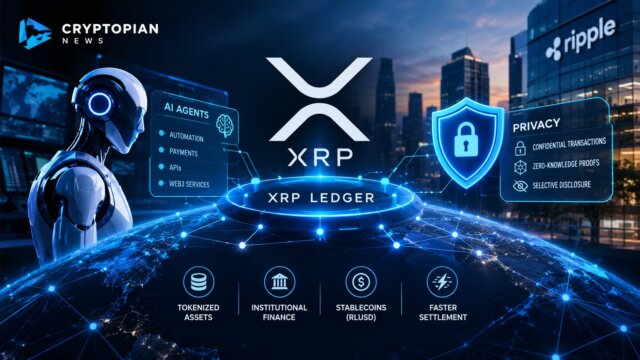
As Ripple and the broader XRPL ecosystem shift their focus towards artificial intelligence, confidential transactions, and institutional blockchain adoption, the XRP Ledger is entering a new era.
During XRP Seoul 2026, Ripple’s engineering executives shared updates regarding their efforts to unlock the network’s capabilities beyond traditional payments. Now, it’s AI agents, privacy-focused transactions, transaction batching and infrastructure for institutional applications.
This transition coincides with a growing trend of AI agents engaging with blockchain networks more often. The number of transactions involving the XRPL-based AI-Agent has now surpassed 11 million, with Ripple’s Senior Director of Engineering Ayo Akinyele commenting at the Seoul event.
With XRPL, users can look forward to a more than just a traditional payment platform.
The XRP Ledger is no different when it comes to swift fund transfers and payments. The fact that it is currently developing in this direction points to a greater objective.
Ripple would like XRPL to cater to financial institutions, tokenized assets, developers and automated software with the network still prioritizing speedy settlements and predictable transaction fees.
The institutional adoption was a key topic at XRP Seoul. Ripple President, Monica Long spoke on topics like moving assets and financial activity on-chain by financial institutions, collateral mobility, tokenized assets and payment infrastructure, etc.
That presents another problem for a public blockchain.
While businesses might want privacy for some transactions, regulators and auditors will want ways to validate the transactions. XRPL’s new privacy enhancements are built around that balance.
The Confidential Transfers Target Institutional Privacy protects institutional privacy.
Confidential Transfers for Multi-Purpose Tokens is one of the most crucial advancements.
The feature enables token holders to maintain private balances and transact amounts without compromising the privacy of their balances while still ensuring that the ledger can verify the validity of transactions using cryptographic proofs. According to XRPL documentation, transaction amounts are protected via encryption and Zero Knowledge Proofs.
This could be important for financial institutions.
A company might want to create a tokenized fund or tokenize some other real world asset on a public blockchain, but not necessarily have every transaction amount public for everyone on the network.
Confidential Transfers offer a way to deal with those instances. A token can have both public and confidential balances, depending on how the issuer and users want to treat specific holdings.
The technology doesn’t ensure the full privacy of XRP Ledger. Rather, it provides supported token issuers and holders with an extra privacy option.
That matters because if institutional blockchain adoption is to happen, there will need to be transparency and controlled disclosure.
The combination of AI and agents is a new use case for XRPL.
Another key component to the XRP Ledger’s new trajectory is artificial intelligence.
To assist developers in creating applications where AI agents can make payments and interact with the network, Ripple earlier this year released its XRPL AI Starter Kit. The toolkit enables payments using XRP and RLUSD via the XRP x402 protocol, including payments for APIs, computing resources and any other digital service.
The idea is simple.
The AI agent might require data from a data source, API calls, or even computing resources. The software can trigger a payment according to a pre-defined instruction, without waiting for a person to complete a payment.
This generates a potential market for payments from machine to machine.
The figures are already making headlines. XRPL has seen over 10 million transactions performed on the network via x402, and recent analysis has suggested that AI agents are responsible for a significant portion of x402 activity in regards to inference and data services.
But numbers of transactions must be interpreted with caution. But high network activity doesn’t necessarily indicate that AI-agent payments have become mass commercial.
The key point is whether these sales become an ongoing economic activity.
The roles of XRP and RLUSD are different.
The AI-agent approach also provides an opportunity for XRP and RLUSD to play a part in the ecosystem.
XRP is the native token of XRP Ledger and can be utilized for value transfers and network expenses. Ripple’s $XRP-backed stablecoin, RLUSD, may be better for transactions where a user would prefer a stable unit of account.
That may be the deciding factor for automatic payments.
An AI agent buying a fixed-price API service may want to choose a dollar-denominated asset, as its cost would be easier to figure out. A service provider might also want to be paid in a stablecoin, instead of a coin that can rise and fall in price quickly.
Ripple’s AI Starter Kit is available for both XRP and RLUSD payment flows, which are x402 enabled.
The outcome is a possible payment layer system that allows for automated software to pay for digital services without completely depending on conventional billing.
Batch Transactions May be Useful in Complex Financial Workflows.
Privacy is not the only technical change taking place on XRPL.
The network also has plans for better batching of transactions. A new amendment to XRPL software, named fixBatchV1_2, was released and is likely to be activated if the threshold level of validators’ support is met.
Multiple transactions can be combined in a batch transaction.
It might be helpful for tokenized assets and for institutional transactions to have multiple actions occur simultaneously. There is also an example of Batch in conjunction with confidential payments on XRPL documentation, which enables settling multiple transfers atomically.
This kind of capability can minimize the chance of a part of a multi-step trade finishing while the rest of the transaction is unsuccessful.
It also provides more flexibility to developers for building financial applications on the ledger.
The significance of this for XRPL adoption.
These latest advancements indicate that Ripple’s strategy extends beyond cross-border payments.
AI agents generate a potential source of automated transaction demand. One of the concerns institutions might have with public blockchains is solved by confidential transfers. More complex financial processes are possible with batch transactions.
All these attributes combined may render XRPL more pertinent for developers developing apps centered on tokenized possession, stablecoins, machine-to-machine commerce, and payments.
The network is still in competition.
Other blockchain ecosystems are also building infrastructure for AI, stablecoins and tokenized assets, such as Ethereum and Solana. Old financial technology firms are also developing automated payment systems.
So, XRPL requires more than just announcements.
Ledger XRP’s Next Steps
The next stage will probably be the developers and the businesses that make use of such features in the real world.
AI agents have the potential to create a fresh type of transaction on XRPL, distinct from traditional human interactions.
The adoption of confidential tokenized assets and the introduction of Batch transactions could further propel XRPL’s standing in the rapidly expanding field of on-chain financial infrastructure.
But there are remaining technical and regulatory issues. AI agents must have robust permission systems and enforced spending caps with robust monitoring. Issuers, auditors and regulators also need to be adequately protected by privacy systems.
Just as XRPL’s developer docs point out, monitoring agent operations is vital via attribution fields and on-chain monitoring.
The route is set for the time being. Ripple and the rest of the XRPL ecosystem are trying to set the blockchain ledger for a world in which blockchain payments are not just done by humans but also by software.
In the event that this market comes to pass as predicted, AI agents, tokenized assets, and privacy may all be significant components of the next phase of XRP Ledger adoption.
The potential of AI Agents as the next big user base for cryptocurrencies.
Tensor Coin (TNSR) Update: 216M Burn, Supply and 2026 Developments
CryptopianNews provides this information for educational and informational purposes only. You should not consider it financial or investment advice. Cryptocurrency markets are highly volatile and speculative, and they carry inherent risks. We advise readers to conduct their own research and to consult with a qualified financial advisor before making any investment decisions.

- As Ripple expands its reach for the next wave of adoption, XRP Ledger makes headway into AI and privacy. - October 4, 2026
- What Is RWA Crypto? How Tokenized Real-World Assets Work in 2026 - October 1, 2026
- BlackRock Says AI Agents Could Bring New Demand to Crypto - September 25, 2026