
Choose a section or paragraph
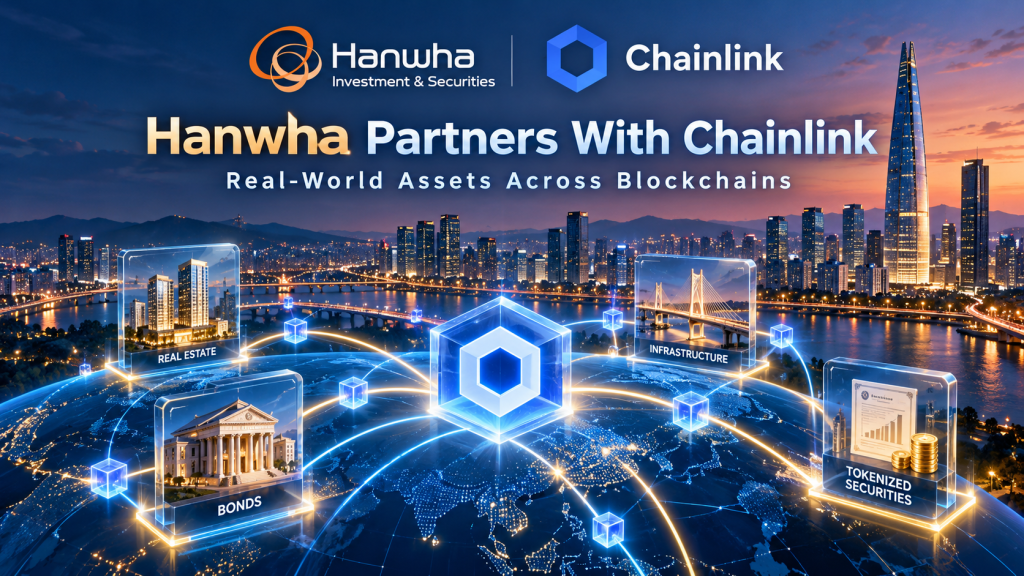
South Korea’s Hanwha Investment & Securities has entered a strategic partnership with Chainlink to develop blockchain infrastructure for the global distribution and use of tokenized real-world assets.
The agreement, announced October 29, places Chainlink’s data standards and Cross-Chain Interoperability Protocol, known as CCIP, at the center of Hanwha’s planned global tokenization platform.
The collaboration extends beyond the creation of digital representations of traditional assets. The companies also intend to explore how tokenized investments can move between networks and potentially be used as collateral within financial markets.
The agreement highlights the growing interest among established financial institutions in making tokenization practical for real investment products.
What Did Hanwha and Chainlink Announce?
Hanwha Investment & Securities said it will adopt Chainlink’s data standards and CCIP as official infrastructure for its tokenization platform.
Chainlink will provide technology supporting financial asset data and communication between blockchain environments.
The partnership includes plans for technical collaboration, institutional connectivity and development of standards for tokenized securities.
Both companies are also forming a joint working group to investigate institutional use cases.
These include compliant onchain transactions, real-world asset collateral and the requirements associated with Korea’s developing tokenized securities market.
What Is Hanwha Investment & Securities?
Hanwha Investment & Securities is a financial-services affiliate of South Korea’s Hanwha group.
The wider group operates across several major industries and is listed among Fortune Global 500 companies.
The involvement of an established securities business is notable because tokenization platforms need more than blockchain technology.
They also require assets, structuring expertise, investment distribution, custody arrangements and relationships with institutional investors.
Hanwha says it is discussing potential tokenized products with global asset managers and issuers.
Those discussions are intended to support eventual distribution to institutional investors and onchain markets.
Why Is Chainlink CCIP Important?
One of the challenges facing tokenized financial assets is fragmentation.
An asset issued on one blockchain may not automatically be accessible or transferable through another blockchain.
Different institutions may also operate on private networks, public networks or combinations of both.
Chainlink’s CCIP is designed to support interoperability between supported blockchain systems.
For Hanwha’s proposed platform, the goal is to enable assets and associated liquidity to reach additional networks without requiring completely separate integrations for every destination.
The arrangement could make it easier for institutions to distribute tokenized financial products across different market environments.
However, interoperability still requires careful management of security, permissions, settlement rules and compliance obligations.
Why Asset Pricing Data Matters
Tokenized assets must represent something economically meaningful.
For example, a tokenized investment-fund interest needs reliable information about its underlying value.
The net asset value, or NAV, may be relevant when investors subscribe, redeem or use the product as collateral.
Chainlink plans to provide pricing and NAV data for assets distributed through the Hanwha platform.
This information could help financial applications understand the value of tokenized assets without relying entirely on manual updates.
Trusted data becomes especially important when assets are used in lending markets.
If collateral is valued incorrectly, borrowers, lenders and other market participants can face financial losses.
Can Real-World Assets Become Blockchain Collateral?
One of the partnership’s longer-term goals is exploring the use of tokenized assets as collateral.
Traditional financial markets already use securities and other assets to support borrowing and financing arrangements.
Tokenization could potentially make some collateral processes more automated and accessible across approved financial platforms.
For example, a token representing an eligible financial instrument might be recognized by a connected lending system.
However, the token’s existence does not automatically give it legal enforceability, acceptable collateral status or sufficient market liquidity.
Institutions must still address ownership rights, custody, valuation, compliance and liquidation procedures.
The Hanwha–Chainlink working group is expected to study several of these issues.
Why South Korea Matters for Tokenization
South Korea is a significant market for digital technology, securities trading and cryptocurrency activity.
As regulatory frameworks develop, financial institutions are examining how blockchain infrastructure can support regulated products.
Tokenized securities present opportunities to modernize financial administration, but they also introduce questions about custody, investor eligibility and financial supervision.
Hanwha’s participation suggests that established market participants increasingly view tokenization as a potential extension of their securities businesses.
The partnership does not mean every proposed product has received regulatory approval or that the platform is already operating at full scale.
Those milestones will need to be verified as the initiative develops.
What Does the Partnership Mean for LINK?
Chainlink’s role as a provider of blockchain interoperability and financial data infrastructure could support its broader institutional positioning.
However, a strategic agreement does not provide a reliable basis for predicting the LINK token’s price.
Investors should watch for real implementation milestones, transaction volumes and evidence of commercial activity.
The announcement does not specify a guaranteed revenue figure or measurable increase in LINK token demand.
Cryptopian News Analysis
The partnership illustrates an important transition in real-world asset tokenization.
The first stage of the market largely focused on demonstrating that traditional assets could be represented on a blockchain.
The next challenge is making those assets usable.
A tokenized security has limited practical value if it cannot reach investors, receive accurate pricing information, comply with transfer restrictions or function within established financial markets.
By combining Hanwha’s financial-market experience with Chainlink’s data and interoperability systems, the companies are attempting to address those barriers.
The real test will be whether the partnership produces functioning products and measurable adoption rather than remaining a technology-development initiative.
What Happens Next?
The companies intend to continue working with asset managers, issuers and institutional participants.
The joint working group will explore standards and use cases, while Chainlink provides dedicated technical support and connections to its financial-institution network.
Readers should watch for announcements identifying specific tokenized assets, supported networks, regulated market participants and production deployments.
Those developments would provide stronger evidence of commercial traction than the partnership agreement alone.
Final Takeaway
Hanwha Investment & Securities and Chainlink are developing infrastructure intended to make tokenized real-world assets more connected, usable and accessible within institutional financial markets.
The partnership brings together a major South Korean financial institution and a blockchain infrastructure provider focused on financial data and interoperability.
Its long-term significance will depend on successful implementation, regulatory compatibility and sustained institutional demand.
Original source: Chainlink and Hanwha official announcement, October 29, 2026:
XRP Ledger Developers Tighten Token Security Rules as Institutional Features Face New Scrutiny
XYZVerse, Chainlink, Pi Network and Shiba Inu Top Crypto Trending Charts
Disclaimer: This report is provided for general information and does not constitute investment advice.

- South Korea’s Hanwha Partners With Chainlink to Bring Real-World Assets Across Blockchains - October 30, 2026
- QuFi Post-Quantum Verification Platform: A New Infrastructure Layer for Digital Assets — A Post-Quantum Verification Platform for Digital Assets - September 4, 2026
- Polygon Leads as Visa Expands Stablecoin Network for Cross-Border Payments - April 29, 2026