
Choose a section or paragraph
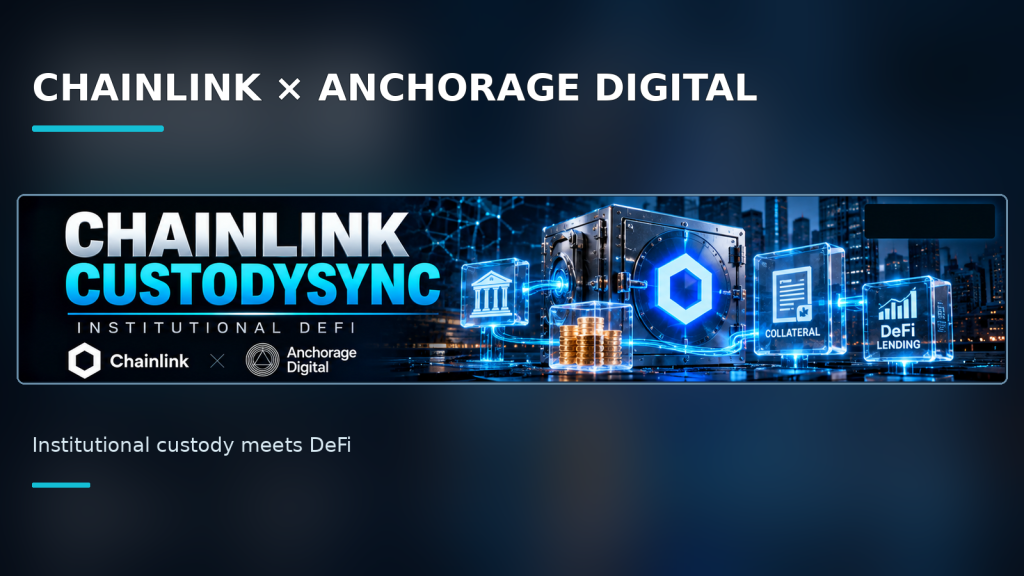
Chainlink has launched CustodySync, a new infrastructure solution designed to connect institutional cryptocurrency custody with decentralized finance lending markets.
Announced as part of the Link 2026 event, the product is launching with Anchorage Digital Bank as its official partner. The development addresses one of the obstacles facing institutional DeFi adoption: how investors can use digital assets as collateral without giving up the custody arrangements and operational controls they rely on.
The launch reflects a growing effort to connect traditional financial safeguards with blockchain-based borrowing and lending systems.
What Is Chainlink CustodySync?
CustodySync is designed to synchronize a qualified custodian’s collateral-management records with a decentralized lending protocol.
In conventional DeFi, users typically transfer collateral into smart contracts before borrowing against it. While this model offers programmable financial services, institutional investors may face restrictions on transferring assets away from approved custody providers.
CustodySync introduces a different arrangement.
A qualified custodian remains responsible for holding and managing assets, while verified data enables a connected lending protocol to recognize the collateral and manage the loan lifecycle.
The system is designed to support deposits, borrowing, repayments and liquidations.
The aim is to allow institutions to access blockchain lending services without abandoning established custody procedures.
Why Anchorage Digital Is Involved
Anchorage Digital Bank is serving as the launch partner for CustodySync.
Its institutional custody infrastructure and Atlas Collateral Management service work alongside lending protocols to coordinate collateral administration.
The arrangement follows a model familiar to institutional financial markets, where specialized providers manage collateral and its associated risks.
Chainlink’s infrastructure provides data coordination between the custodian and the blockchain-based lending environment.
That distinction matters because financial institutions generally require clear responsibilities for asset custody, valuation and liquidation before using new lending infrastructure.
How the Technology Works
Chainlink says CustodySync combines several components of its infrastructure, including the Chainlink Runtime Environment, Data Feeds, Data Streams and Proof of Reserve.
These systems help connect independently operated financial environments with verified information.
The custodian maintains the authoritative record of collateral balances, while the lending protocol operates the borrowing market.
Both systems rely on synchronized data to understand the state of the loan.
For example, when a borrower repays an obligation, the connected systems need consistent information about the outstanding balance and the collateral that can be released.
If collateral values fall, liquidation arrangements must also be coordinated.
The technical challenge is not simply moving information between systems. It is ensuring that the information remains accurate and sufficiently timely for financial risk management.
Why This Matters for Institutional DeFi
Institutional investors may hold digital assets they would like to use for financing without selling them.
Borrowing against collateral can help organizations manage liquidity while retaining their underlying holdings.
However, many institutions cannot simply move valuable assets into unfamiliar smart contracts.
Custody rules, internal risk policies and counterparty requirements may limit how assets can be transferred.
CustodySync attempts to bridge that gap by combining qualified custody with decentralized lending functionality.
The model could make DeFi more accessible to institutions that previously avoided direct participation.
Still, the launch does not mean institutional investors have collectively committed billions of dollars to these services.
Actual participation, financing volumes and supported markets will determine the product’s commercial significance.
What Does This Mean for the LINK Token?
Chainlink’s expanding role in institutional financial infrastructure may draw attention to LINK, the network’s native token.
However, investors should distinguish between product adoption and token demand.
The CustodySync announcement does not, by itself, establish the volume of LINK required by participating institutions or guarantee a positive price reaction.
Any long-term effect will depend on actual infrastructure usage, service economics and the relationship between the product and Chainlink’s token ecosystem.
The Risks That Still Need Attention
Connecting custodians to DeFi markets does not eliminate the financial risks of lending.
Collateral values can decline suddenly, liquidity can become insufficient during volatile conditions, and operational failures can affect loan administration.
Smart-contract vulnerabilities remain relevant, even when assets are held by qualified custodians.
Institutions must also assess legal enforceability, liquidation rights, data reliability and the performance of the systems connecting onchain and offchain processes.
These risks are especially important when different organizations are responsible for different stages of a transaction.
Cryptopian News Analysis
The most interesting aspect of CustodySync is the attempt to change how institutions participate in DeFi.
For years, decentralized lending largely relied on users transferring digital assets directly into blockchain protocols.
Institutional adoption may require more flexible structures that respect traditional custody obligations while allowing financial activity to occur onchain.
Chainlink and Anchorage Digital are pursuing that approach.
Whether it succeeds will depend less on the product announcement and more on lending-market adoption, operational performance and actual demand from institutional borrowers.
Final Takeaway
Chainlink’s CustodySync launch with Anchorage Digital represents another step toward integrating decentralized finance with regulated institutional infrastructure.
It offers a framework through which custodied assets may become usable in onchain lending markets without requiring institutions to abandon familiar safeguards.
The next important milestones will be participating lending protocols, institutional adoption and measurable collateral activity.
Original source: https://chain.link/blog/link-nyc-recap-2026
XYZVerse Adopts Chainlink Data Feeds for Gaming Hub on BNB Chain
XYZVerse, Chainlink, Pi Network and Shiba Inu Top Crypto Trending Charts
Disclaimer: This article is for informational purposes and does not constitute investment advice.

- Chainlink Launches CustodySync With Anchorage Digital to Bring Institutional Capital Into DeFi - October 30, 2026
- Ripple’s RLUSD Lands on Coinbase as Stablecoin Expansion Accelerates - October 29, 2026
- Tensor Coin (TNSR) Update: 216M Burn, Supply and 2026 Developments - October 3, 2026