
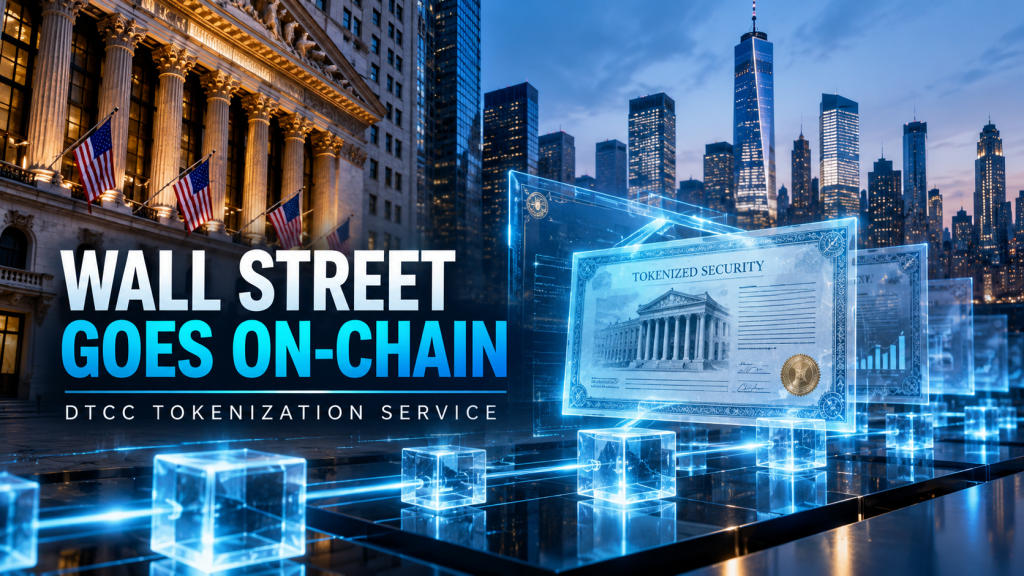
Wall Street’s adoption of blockchain technology has reached a new milestone. The Depository Trust & Clearing Corporation (DTCC) announced on October 28 that its Tokenization Service is officially live, allowing eligible financial institutions to create tokenized representations of securities held within established market infrastructure.
The development is significant because it moves tokenization further beyond experimental blockchain projects and into infrastructure used by major global banks and financial firms.
According to DTCC, 20 Depository Trust Company participants have already signed agreements to access the service. They include JPMorgan, Bank of America, Morgan Stanley, Barclays, Citi, UBS and Fidelity Investments.
What Has DTCC Actually Launched?
The DTCC Tokenization Service allows eligible users to convert certain traditional securities entitlements into tokenized representations that can be managed through registered digital wallets.
These representations are designed to preserve the economic rights and investor protections associated with the underlying traditional assets.
In practical terms, securities can be represented and transferred using supported blockchain infrastructure while remaining connected to the regulated custody environment.
DTCC says the service is designed to improve liquidity, collateral mobility and capital efficiency. That matters because large financial institutions routinely move securities as collateral across trading, borrowing and financing operations.
If those movements become faster and more flexible, institutions may be able to use existing financial assets more efficiently.
Major Banks Are Participating
The list of participating institutions demonstrates the scale of interest in tokenized financial infrastructure.
DTCC identified 20 participants with signed agreements and said additional firms will join over time.
Its broader development process involved input from more than 150 financial companies through an industry working group.
The service currently integrates with the Canton Network and DTCC’s private Besu network. DTCC plans to add further blockchain networks in 2027.
The choice of networks also illustrates an important distinction: institutional blockchain adoption does not always mean moving securities onto a completely open, permissionless trading venue.
Financial institutions often require identity controls, regulatory safeguards, operational oversight and systems that work with existing financial infrastructure.
Why This Matters for the $114 Trillion Securities Infrastructure
DTCC reports that its depository subsidiary holds more than $114 trillion in assets under custody and servicing.
That figure represents the scale of DTCC’s existing securities infrastructure, not the value of assets already tokenized through the new service.
The distinction matters. The launch does not mean that $114 trillion has moved onto blockchain networks.
Instead, DTCC is building a regulated route through which eligible securities can increasingly be represented and used in digital environments.
That creates a potentially important foundation for the tokenization of equities, ETFs and U.S. Treasury securities.
Could Tokenized Securities Change Traditional Finance?
Tokenization could eventually reduce the operational friction involved in moving securities between approved market participants.
One possible benefit is faster collateral transfer. When institutions need to pledge assets against financial obligations, delays can tie up liquidity.
A digital representation that can move efficiently between authorized wallets may improve operational flexibility.
However, the wider benefits depend on adoption, supported assets, legal enforceability, market liquidity and interoperability between financial institutions.
It is also important to separate token transfers from securities trading. The ability to transfer a tokenized security does not automatically mean its underlying market can trade around the clock.
What Happens Next?
DTCC says more participants will be onboarded and additional blockchain networks are planned for 2027.
The important developments to monitor will be actual transaction volumes, participating institutions, the range of eligible assets and how effectively the service integrates with existing market systems.
For blockchain companies, the announcement provides another example of traditional financial infrastructure adopting distributed-ledger technology for practical business purposes.
For investors, it signals a growing institutional interest in asset tokenization, although the launch itself does not establish a direct price outlook for cryptocurrencies associated with the supported networks.
Final Takeaway
The DTCC launch represents a shift from demonstrating tokenization’s technical possibilities to offering a service within established securities infrastructure.
Whether it becomes transformative will depend on how extensively financial institutions use it.
What is already clear is that blockchain-based securities are becoming a more concrete part of Wall Street’s infrastructure strategy.
Source: DTCC official announcement, October 28, 2026 — https://www.dtcc.com/press-releases/2026/dtcc-tokenization-service-goes-live
CFTC Moves Toward New US Crypto Trading Rules: What Could Change for Exchanges?
Ethereum Glamsterdam Upgrade Delayed on Hoodi Testnet: What Happens Next?
Disclaimer: This article is for informational purposes only and does not constitute investment advice.

- Wall Street Goes On-Chain as DTCC Launches Tokenization Service - October 29, 2026
- CFTC Moves Toward New US Crypto Trading Rules: What Could Change for Exchanges? - October 28, 2026
- Ethereum Glamsterdam Upgrade Delayed on Hoodi Testnet: What Happens Next? - October 28, 2026