
Choose a section or paragraph
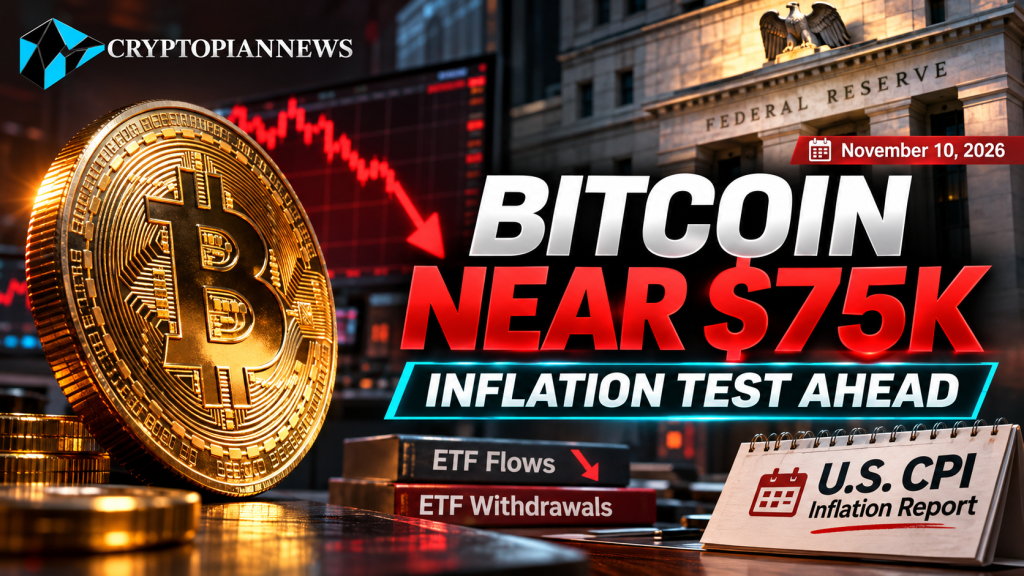
Bitcoin is approaching another critical test after a difficult week for cryptocurrency investors. With the world’s largest digital asset trading around the $75,000 region, attention is shifting toward a major U.S. inflation report that could influence interest-rate expectations and the direction of the broader crypto market.
The October Consumer Price Index (CPI) is scheduled for release on Tuesday, November 10, at 8:30 a.m. Eastern Time.
For Bitcoin investors, the stakes extend beyond a single inflation figure.
Recent selling pressure, withdrawals from spot Bitcoin exchange-traded funds (ETFs), and uncertainty about U.S. cryptocurrency regulation have made the market particularly sensitive to economic news.
The question now is whether inflation data will provide relief—or add another source of pressure to an already nervous market.
Why Is Bitcoin Struggling Near $75,000?
Bitcoin’s latest weakness follows a volatile start to November.
The cryptocurrency climbed above $80,000 on November 4 before losing momentum as technology stocks weakened and investors reduced exposure to risk-sensitive assets.
By November 9, Bitcoin had slipped toward $74,400 during early U.S. trading, according to Investing.com’s market report.
A November 10 report from Chosun Biz also described Bitcoin trading around the $75,000 level amid regulatory concerns and ETF outflows.
The retreat highlights how quickly market sentiment can change.
A recovery attempt does not necessarily signal that selling pressure has disappeared. Traders are watching whether Bitcoin can stabilize following the latest decline or whether fresh macroeconomic developments will encourage further selling.
Cryptopian News previously examined how Bitcoin rebounded after more than $1 billion in crypto liquidations, revealing the effect that leveraged trading can have on short-term price movements.
Today’s US Inflation Report Could Change Market Expectations
The U.S. Bureau of Labor Statistics is scheduled to publish October’s CPI report at 8:30 a.m. ET on November 10.
CPI measures changes in the prices consumers pay for goods and services, making it an important indicator of inflation.
Investors will focus particularly on two figures:
- Headline CPI: Overall consumer price inflation.
- Core CPI: Inflation excluding food and energy, which can provide a clearer view of underlying price pressures.
Why does this matter for Bitcoin?
Inflation influences expectations about Federal Reserve monetary policy.
If inflation remains unexpectedly high, investors may anticipate tighter monetary policy or higher interest rates for longer. That can place pressure on speculative assets, including cryptocurrencies.
If inflation comes in below expectations, markets may reassess the likelihood of further monetary tightening.
However, a favorable inflation reading does not guarantee that Bitcoin will rise. Equity-market sentiment, leverage, liquidity and institutional investment flows can also affect prices.
Bitcoin ETF Withdrawals Add Another Concern
Institutional demand has become an increasingly important part of the cryptocurrency market.
Spot Bitcoin ETFs allow investors to gain price exposure through conventional brokerage accounts without directly managing private cryptocurrency wallets.
Those products have also experienced periods of significant selling pressure.
According to The Block, U.S. spot Bitcoin ETFs recorded approximately $643.3 million in net outflows on October 30, the largest daily withdrawal total in roughly four months at the time.
The selling pressure continued into November.
Cryptopian News previously reported approximately $430.2 million in net outflows during the November 5 trading session.
Although ETF withdrawals can indicate declining demand for fund shares, they should not be interpreted as proof that all institutional investors are abandoning Bitcoin.
The more important question is whether redemptions continue or whether demand stabilizes.
Sustained ETF inflows could help improve sentiment. Continued withdrawals could complicate Bitcoin’s recovery.
Could Regulatory Uncertainty Make the Selloff Worse?
The U.S. political environment is another issue weighing on cryptocurrency sentiment.
Following the November midterm elections, investors have been reassessing the outlook for federal cryptocurrency legislation and oversight.
Potential changes to market structure rules, exchange supervision and investor protections could affect how digital asset businesses operate.
Some market participants favor tighter safeguards because they may strengthen consumer protection and institutional confidence.
Others worry that regulatory uncertainty and additional compliance obligations could discourage trading and investment.
It is too early to conclude precisely how the next legislative agenda will affect Bitcoin prices.
Nevertheless, the debate has added another variable to an already volatile market.
The Binance Hack Has Also Put Crypto Security Back in Focus
Recent market uncertainty has arrived alongside renewed questions about centralized cryptocurrency exchange security.
The reported $6.3 billion Binance breach in late October raised concerns about custody, exchange infrastructure and operational resilience.
Binance subsequently announced measures to cover losses and restore customer confidence.
Cryptopian News investigated the Binance $6 billion recovery and the questions that remain.
Our separate investigation also examined the 628 cryptocurrency wallets identified in connection with the Binance hack.
These developments do not establish that the hack caused Bitcoin’s latest price decline.
However, they demonstrate why security, institutional confidence and risk management remain important themes for cryptocurrency investors.
Three Bitcoin Price Scenarios After the CPI Report
Bitcoin’s next move will depend on how the inflation data compares with market expectations and how investors react.
Scenario 1: Inflation comes in below expectations
A softer reading could ease concerns about further monetary tightening.
Bitcoin might benefit if risk appetite improves and ETF selling pressure stabilizes.
However, a positive market reaction is not guaranteed.
Scenario 2: Inflation comes in above expectations
An unexpectedly strong inflation reading could reinforce expectations of higher interest rates.
That could place additional pressure on cryptocurrencies, particularly if technology stocks and other risky assets weaken.
Leveraged positions could amplify short-term market movements.
Scenario 3: Inflation matches expectations
If the report provides few surprises, Bitcoin may remain sensitive to ETF flows, U.S. equity markets and broader regulatory developments.
A relatively calm initial reaction could still be followed by volatility as investors digest the details.
What Bitcoin Investors Should Watch Next
Beyond the immediate CPI release, several indicators deserve attention.
The first is whether Bitcoin can maintain stability near its recent trading range without renewed aggressive selling.
The second is the direction of U.S. spot Bitcoin ETF flows.
The third is the response of U.S. stock markets, particularly technology shares that have recently moved alongside cryptocurrencies during periods of risk aversion.
Investors should also monitor derivatives markets for signs of excessive leverage and forced liquidations.
Finally, Federal Reserve commentary and upcoming economic reports could shape expectations for the December policy decision.
Is Bitcoin Heading for Another Crash or a Recovery?
The answer remains uncertain.
Bitcoin’s decline toward $75,000 reflects a combination of weaker market sentiment, institutional fund withdrawals and economic uncertainty.
Today’s inflation report provides a near-term catalyst, but a single economic release cannot determine Bitcoin’s longer-term direction.
A sustained recovery would likely require improving demand, healthier market positioning and greater confidence across financial markets.
Conversely, disappointing inflation data or renewed ETF withdrawals could extend volatility.
For now, Bitcoin investors face a crucial question: Will the latest selloff become a turning point—or another stage in a deeper correction?
The market’s reaction to the November 10 inflation report may offer an important early indication.
- Bitcoin rebounds after $1 billion in liquidations
- Binance $6 billion recovery investigation
- FBI identifies 628 wallets in Binance investigation
Sources and References
- U.S. Bureau of Labor Statistics — Official CPI Release Schedule
- Investing.com — Bitcoin Slips to $74K as Regulatory Uncertainty and ETF Outflows Weigh
- Chosun Biz — Bitcoin Dips Near $75,000
- The Block — Spot Bitcoin ETF Outflows After Binance Hack
- Reuters — Binance Clients Withdraw Funds Following Hack
Market prices and fund-flow figures refer to the reporting dates identified above and are not live quotes. The CPI results were not yet available at the time this article was prepared.
Disclaimer: This article is provided for informational purposes only and does not constitute financial advice.

- Bitcoin Price Near $75,000: Why Today’s US Inflation Report Could Trigger a Bigger Crypto Move - November 10, 2026
- Bitcoin Rebounds Toward $76,000 After $1 Billion Liquidation Wave Shakes Crypto Markets - November 6, 2026
- Ripple’s RLUSD Stablecoin Lands on Coinbase, Expanding Access Across XRP Ledger, Ethereum and Base - November 1, 2026