
Choose a section or paragraph
Wall Street is moving another step toward blockchain-based financial markets.
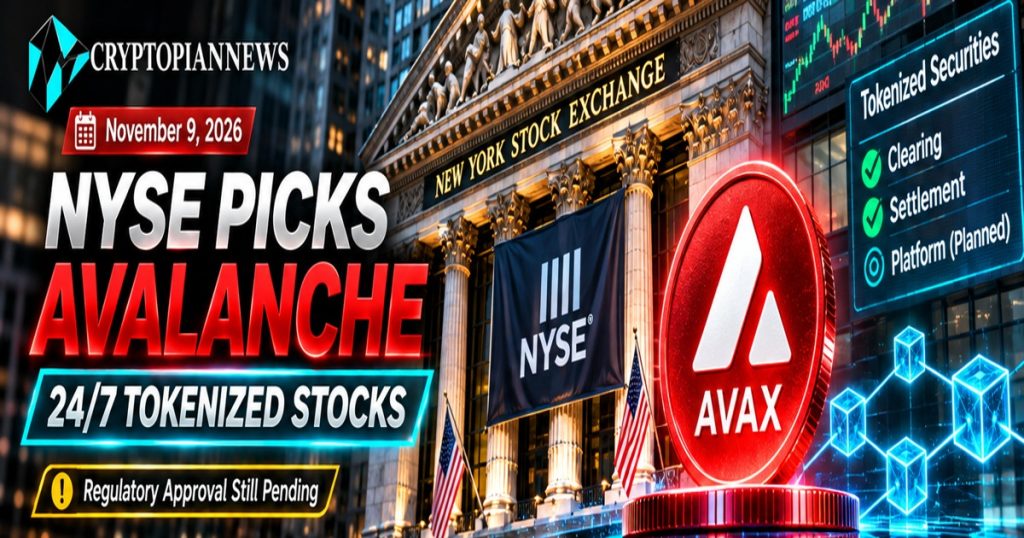
The New York Stock Exchange (NYSE) has selected Avalanche technology to support clearing and settlement for a planned tokenized securities trading platform, according to announcements released on November 9.
The proposed system aims to support trading, clearing and settlement around the clock, potentially bringing traditional stock-market infrastructure closer to the always-on nature of cryptocurrency markets.
However, the new platform remains subject to regulatory approval.
The development raises an important question: Could blockchain technology eventually change how investors buy, sell and settle traditional stocks?
Why Did NYSE Select Avalanche?
Ava Labs announced that Avalanche will provide core ledger technology for the clearing firm supporting the upcoming NYSE-affiliated alternative trading system.
The technology is intended to record and settle transactions with the speed, operational controls and predictable performance required by financial institutions.
Traditional stock markets operate within defined trading sessions, while cryptocurrency networks can generally process transactions around the clock.
NYSE’s proposed system seeks to bring some of that flexibility to tokenized securities.
The exchange plans to use existing market technology for trade matching, while Avalanche would support settlement infrastructure.
Importantly, that does not mean every NYSE-listed stock is immediately moving onto Avalanche.
The new service is a separate, planned trading venue whose launch depends on regulatory and operational requirements.
What Are Tokenized Stocks?
Tokenized stocks are digital representations of securities recorded on blockchain-based infrastructure.
Depending on their legal structure, these tokens may represent ownership interests in shares or other securities.
For investors, tokenization could eventually support faster settlement, expanded trading hours and improved integration with digital financial systems.
However, tokenization does not automatically eliminate brokerage rules, securities regulation or investor-protection requirements.
NYSE’s proposed system is designed to connect blockchain technology with established financial-market infrastructure rather than replace securities regulation altogether.
Why 24/7 Stock Trading Matters
One of the biggest differences between traditional securities markets and cryptocurrencies is trading availability.
Bitcoin and other major cryptocurrencies trade continuously, including weekends and holidays.
Most U.S. stock trading remains concentrated around scheduled market hours, although extended-hours services already exist.
A regulated venue supporting around-the-clock trading could allow eligible participants to react to market developments without waiting for the next conventional session.
The potential advantages include greater flexibility for international investors and more continuous price discovery.
But there are challenges.
Overnight liquidity, market surveillance, operational resilience and investor protections will remain important considerations.
Could Avalanche Benefit from the NYSE Partnership?
The selection is a significant institutional technology milestone for the Avalanche ecosystem.
It demonstrates that established financial-market operators are evaluating blockchain infrastructure for uses beyond cryptocurrency speculation.
Nevertheless, the partnership should not be confused with a guarantee of increased demand for the AVAX token.
The proposed system is expected to use controlled infrastructure, and the economic relationship between that infrastructure and public-network token demand has not been fully established.
Any effect on AVAX trading activity or valuation would depend on actual implementation and usage.
Investors should distinguish a confirmed business partnership from projections about token prices.
What Happens Next?
Several developments will determine whether the project achieves its ambitions.
First, the platform must satisfy applicable regulatory requirements.
Second, its operators will need to demonstrate reliable clearing, settlement and compliance processes.
Third, financial institutions and eligible investors must find sufficient value in the new trading model.
Finally, broader adoption will depend on liquidity, access rules, security and the practical costs of operating tokenized securities.
A successful launch could encourage additional financial institutions to explore similar technology.
But widespread adoption is far from guaranteed.
The Bigger Picture: Wall Street Is Taking Blockchain More Seriously
For years, the cryptocurrency industry has argued that blockchains could transform financial-market infrastructure.
NYSE’s Avalanche initiative represents a concrete example of that possibility being explored by an established exchange operator.
The significance is not that traditional stocks are suddenly becoming cryptocurrencies.
It is that institutions responsible for conventional financial markets are testing whether blockchain technology can improve existing systems.
As financial services converge with digital assets, the distinction between conventional trading infrastructure and blockchain networks may continue to evolve.
For now, the key question is no longer simply whether Wall Street is interested in tokenization.
It is whether institutions can turn that interest into scalable, regulated financial services.
The development follows another major institutional blockchain milestone, when Cryptopian News reported that DTCC launched its Wall Street tokenization service
Sources
- Ava Labs — Official NYSE-Avalanche Announcement
- NYSE — November 9 Content Update
- The Block — NYSE Selects Avalanche

- New York Stock Exchange Picks Avalanche for 24/7 Tokenized Stock Trading: What It Means for Crypto - November 10, 2026
- GOPAX Halts Trading and Withdrawals After Hack Threat: What Happened to Customer Funds? - November 6, 2026
- US Finalizes New Stablecoin Rules Under GENIUS Act as January 2027 Deadline Approaches - November 1, 2026