
Choose a section or paragraph
Germany’s largest bank has taken a major step into the cryptocurrency industry.
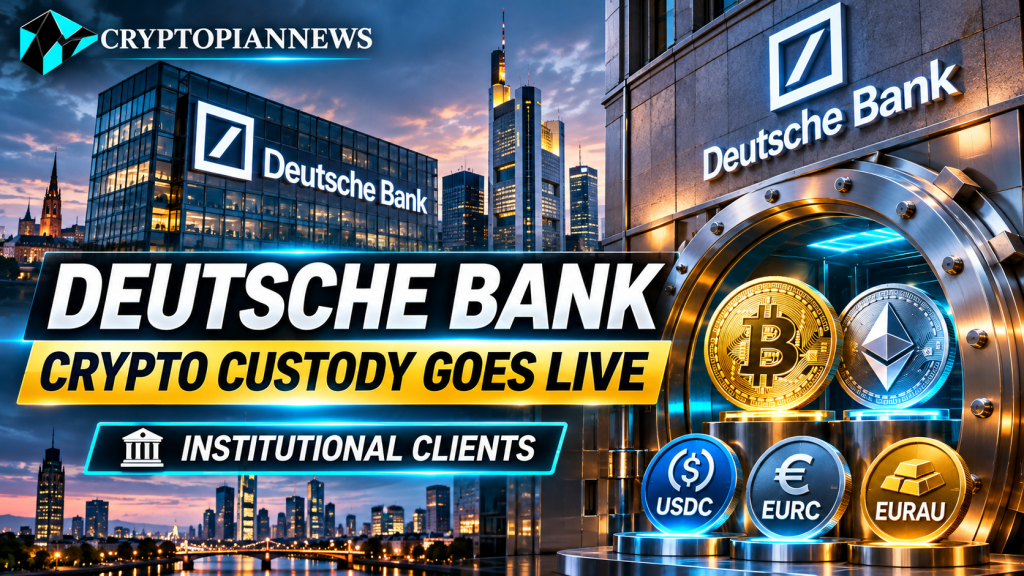
Deutsche Bank confirmed on November 11 that its digital asset custody service is now operating for paying clients, allowing eligible institutions and corporations to safeguard selected cryptocurrencies through established banking infrastructure.
The service supports Bitcoin, Ethereum and selected stablecoins, marking a transition from the bank’s earlier announcement to an operational offering.
The development raises a question for cryptocurrency investors: What happens when traditional banks begin securing digital assets for their institutional clients?
Deutsche Bank’s Crypto Service Is Now Live
Deutsche Bank first outlined its plans for European digital asset custody in September 2026.
At the time, the bank described an offering designed to help corporate and institutional clients store and transfer cryptocurrencies without independently managing every aspect of their custody systems.
On November 11, Reuters confirmed that the bank had begun providing the service to paying customers.
The launch represents a commercial milestone rather than another announcement about future intentions.
The initial offering focuses on custody and transfers, not the launch of a cryptocurrency exchange for everyday retail banking customers.
That distinction matters because digital asset custody requires different infrastructure, controls and regulatory obligations from conventional crypto trading.
Which Cryptocurrencies Does Deutsche Bank Support?
The initial offering includes five digital assets:
- Bitcoin (BTC)
- Ethereum (ETH)
- USD Coin (USDC)
- EURC
- EURAU
Bitcoin and Ethereum are the two largest established cryptocurrency networks by market capitalization, while the selected stablecoins provide exposure to digital tokens linked to conventional currencies.
For institutional customers, the attraction is the ability to hold these assets through a recognized banking provider instead of directly managing all the private-key infrastructure themselves.
However, cryptocurrency holdings are not equivalent to insured bank deposits.
Digital assets remain subject to market volatility, cybersecurity risks and regulatory requirements.
Why Crypto Custody Matters for Institutional Investors
Cryptocurrency ownership depends on controlling the private keys that authorize transactions.
For individual investors, this responsibility may involve hardware wallets, recovery phrases and secure backups.
For an institution managing substantial assets, custody becomes more complicated.
Businesses must establish appropriate controls for transaction authorization, access management, compliance, reconciliation, recordkeeping and recovery procedures.
A regulated banking provider can potentially simplify these operational requirements.
Deutsche Bank’s custody infrastructure includes security measures such as hardware-based key protection and multiple-person authorization for certain operations.
These controls can reduce some operational risks, although no custody solution can eliminate every threat.
Deutsche Bank Is Also Exploring Tokenized Investments
Alongside the custody launch, Deutsche Bank announced a memorandum of understanding with Deutsche Asset Management, the investment manager formerly known as DWS.
The arrangement is intended to explore cooperation involving tokenized money market funds, cryptocurrency exchange-traded commodities and stablecoins.
Tokenization involves representing financial assets or claims using digital records on blockchain-based infrastructure.
For financial institutions, potential uses include more efficient transfers, automated administration and closer integration between traditional securities and digital payment systems.
However, the new agreement is exploratory.
It does not mean Deutsche Bank has already launched every proposed tokenized investment product.
Could This Bring More Institutional Money Into Bitcoin?
Deutsche Bank’s entry into digital asset custody could make it easier for some eligible institutions to access cryptocurrencies through familiar service providers.
That may improve confidence among organizations whose investment policies require established custody arrangements.
Nevertheless, the launch does not prove that significant new capital has already entered Bitcoin or Ethereum.
The bank has not disclosed detailed figures for assets held in the new custody service or the number of participating clients.
Any effect on cryptocurrency prices will depend on actual adoption, investor demand and broader market conditions.
European Banks Are Becoming More Active in Crypto
The launch comes as European financial institutions adapt to the European Union’s Markets in Crypto-Assets regulatory framework, commonly known as MiCA.
The framework provides rules for various crypto-asset activities, including custody and transfers.
Regulatory requirements do not remove investment risk, but they establish clearer conditions for businesses seeking to provide digital asset services.
Deutsche Bank is also looking beyond its initial European rollout, with Reuters previously reporting plans to expand toward major Asian financial centers.
For a wider perspective on institutional blockchain infrastructure, Cryptopian News has covered how DTCC advanced tokenization on Wall Street.
What Should Investors Watch Next?
Three developments will help determine the significance of Deutsche Bank’s crypto expansion.
First, whether more institutional customers begin using its custody platform.
Second, whether its asset-management collaboration leads to approved, commercially available products.
Third, whether the bank extends its digital asset operations into additional markets and settlement services.
The launch establishes a new channel through which eligible institutions can hold certain digital assets.
It does not guarantee higher cryptocurrency prices or the replacement of traditional banking systems.
The Bigger Picture
Deutsche Bank’s crypto custody launch illustrates how traditional financial institutions are beginning to integrate blockchain infrastructure into existing services.
Instead of treating cryptocurrencies exclusively as assets traded on specialized exchanges, banks are developing ways to safeguard and transfer them within regulated financial operations.
For the cryptocurrency industry, the most important development may not be a short-term Bitcoin price movement.
It may be the gradual incorporation of digital assets into the infrastructure that already supports international finance.
Traditional banks are no longer only discussing cryptocurrency custody. Some are now delivering it to clients.
Sources
- Reuters — Deutsche Bank Launches Digital Asset Custody Service
- The Block — Deutsche Bank Launches Custody and Signs Asset-Management Agreement
Disclaimer: This article is for informational purposes and does not constitute investment advice.

- Deutsche Bank Launches Bitcoin and Ethereum Custody: Is Traditional Banking Entering a New Crypto Era? - November 12, 2026
- Bitcoin Price Near $75,000: Why Today’s US Inflation Report Could Trigger a Bigger Crypto Move - November 10, 2026
- Bitcoin Rebounds Toward $76,000 After $1 Billion Liquidation Wave Shakes Crypto Markets - November 6, 2026