
Choose a section or paragraph
Important points:
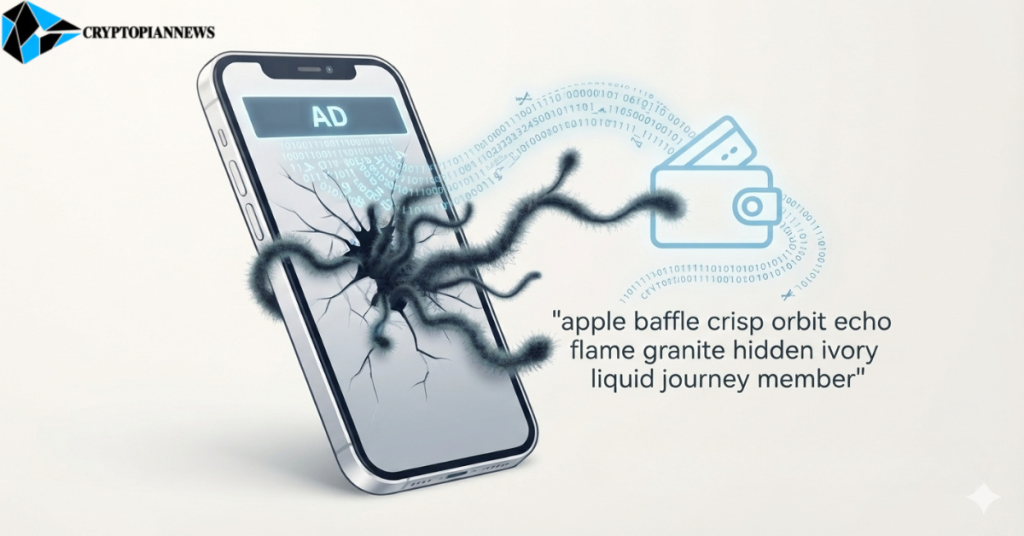
- MoldyRoost is a malicious advertising operation that reportedly targets iPhone users through deceptive advertisements and compromised advertising infrastructure.
- Attackers use malicious ad redirects to expose cryptocurrency users to fake wallet-related pages.
- A single tap can potentially expose sensitive wallet information if users enter their recovery phrases on fraudulent websites.
- Cryptocurrency seed phrases provide complete access to self-custody wallets, making them valuable targets for cybercriminals.
- iPhone users should avoid suspicious advertisements, verify wallet applications, and never share recovery phrases online.
- Hardware wallets, transaction verification, and secure browsing habits can reduce exposure to cryptocurrency theft.
What Is MoldyRoost Malware and How Does It Target iPhones?
The cybersecurity threat known as MoldyRoost highlights a growing connection between malicious advertising and cryptocurrency theft. Unlike conventional phishing campaigns, this operation does not always require victims to download suspicious applications or enter sensitive information manually.
According to cybersecurity researchers at Confiant, MoldyRoost operates through a sophisticated malvertising infrastructure designed to deliver powerful iOS exploit kits. Its advertisements appear on seemingly legitimate websites, making the operation particularly dangerous for unsuspecting iPhone owners.
The investigation published on November 20, 2026, revealed the campaign’s extensive reach. Researchers identified more than 480 advertising domains between May 12 and November 17, 2026. Furthermore, these domains targeted users across more than 47 countries.
How the attack works
MoldyRoost combines programmatic advertising, hidden landing pages, device fingerprinting, and exploit delivery. Consequently, an advertisement can become the starting point of a serious cybersecurity incident.
The operation generally follows this sequence:
- Malicious advertisement: Attackers purchase advertising placements through advertising networks and distribute deceptive advertisements across legitimate websites.
- Redirect mechanism: When someone taps an advertisement, the browser loads an attacker-controlled landing page.
- Device identification: Hidden scripts examine the device model, iOS version, browser, and other technical information.
- Exploit selection: The attacker’s infrastructure selects an exploit chain compatible with the identified device.
- Data extraction: If the exploit succeeds, malicious code can access sensitive information stored on the compromised device.
Importantly, researchers reported that simply loading a malicious landing page could compromise an iPhone running a vulnerable iOS version. Therefore, users do not necessarily need to download a file, install an application, or execute a suspicious command.
This technique makes the campaign particularly concerning because ordinary browsing activity can expose vulnerable devices to sophisticated attacks.
How MoldyRoost Ads Steal Seed Phrases Through iOS Exploits
The most dangerous aspect of this operation involves cryptocurrency wallet recovery phrases. These phrases, commonly containing 12 or 24 words, function as master credentials for self-custody wallets.
Anyone possessing a valid recovery phrase may restore the associated wallet on another device. Therefore, attackers who obtain these words can potentially transfer cryptocurrency without the owner’s permission.
Confiant identified several exploit families associated with the operation, including Coruna, DarkSword, SilkPath, and GhostWave. These exploit kits contain different vulnerability chains that target particular iOS versions.
Why cryptocurrency wallets become vulnerable
The problem extends beyond cryptocurrency applications themselves. Many users save recovery phrases in Apple Notes, screenshots, photographs, or messaging applications for convenience.
However, storing sensitive credentials in ordinary phone storage creates additional security risks.
According to Confiant’s investigation, the Coruna exploit can search Apple Notes for wallet recovery phrases and examine QR codes stored in images. Meanwhile, DarkSword can collect additional information, including keychain data, messages, photographs, and wallet-related information.
This explains why the threat deserves attention beyond the cryptocurrency community.
For example, an investor might store a recovery phrase inside Apple Notes to avoid losing access to a wallet. If an attacker successfully compromises that iPhone, the stored information could become accessible.
The attacker can then restore the wallet elsewhere and initiate unauthorized transactions. Because blockchain transactions generally cannot be reversed, recovering stolen cryptocurrency can become extremely difficult.
The four exploit families identified by Confiant:
| Exploit family | Reported role |
|---|---|
| Coruna | Targets wallet applications and searches stored recovery phrases |
| DarkSword | Extracts wallet information and other sensitive device data |
| SilkPath | Provides an additional exploit route for certain iOS versions |
| GhostWave | Includes a separate delivery branch for newer device configurations |
These findings demonstrate that MoldyRoost is not simply a fake cryptocurrency advertisement. Instead, it represents an organized distribution operation using sophisticated mobile exploitation techniques.
Why the MoldyRoost Campaign Is Difficult to Detect
One reason this campaign presents such a serious challenge is its ability to disguise malicious activity as ordinary internet advertising.
Confiant discovered that MoldyRoost uses a technique called cloaking. This technology allows attackers to display different content depending on the visitor’s device, browser, and location.
For instance, someone visiting a malicious advertisement from a desktop computer might see a harmless webpage. However, an iPhone user could receive a hidden exploit instead.
Furthermore, the researchers identified six operational sub-clusters, labeled A through F. Each cluster maintained different advertising domains and delivery mechanisms while drawing on related exploitation infrastructure.
The connection with previously identified iOS vulnerabilities
The investigation also connects MoldyRoost with previously documented exploitation campaigns.
Google Threat Intelligence Group and iVerify published research about Coruna and DarkSword in March 2026. According to Confiant, these exploit families subsequently appeared within MoldyRoost’s advertising infrastructure.
However, users should distinguish between confirmed vulnerabilities and unverified exploitation claims.
For example, researchers documented Coruna’s exploitation range across iOS 13.0–17.2.1. DarkSword targeted iOS 18.4–18.7, while Apple addressed its six identified vulnerabilities through subsequent security updates. Confiant also stated that it had not observed working iOS 26 exploit code in its investigation.
How iPhone users can protect their cryptocurrency wallets
Although sophisticated exploit campaigns present significant risks, users can reduce their exposure through practical security measures.
Here are several important precautions:
- Update iOS immediately: Install the latest available security updates because outdated software may contain exploitable vulnerabilities.
- Avoid storing recovery phrases digitally: Never keep wallet seed phrases in Apple Notes, screenshots, photographs, or messaging applications.
- Use hardware wallets: Keep substantial cryptocurrency holdings in reputable hardware wallets and protect their recovery credentials separately.
- Avoid suspicious advertisements: Do not interact with unexpected advertisements promising free cryptocurrency, investment opportunities, or wallet rewards.
- Verify wallet applications: Download wallet software through official sources and carefully verify application developers.
- Monitor wallet activity: Regularly examine transaction histories and investigate unfamiliar transfers or account activity.
- Secure important accounts: Enable available authentication protections and use strong, unique passwords.
If you suspect that your iPhone has been compromised, stop using it for sensitive financial activities. Use a separate, trusted device to secure your accounts and move remaining assets to a newly created wallet with a securely generated recovery phrase.
Most importantly, never enter an existing recovery phrase into an unfamiliar website, application, or advertisement.
The MoldyRoost investigation demonstrates how cybercriminals can exploit the advertising ecosystem to reach cryptocurrency investors. More importantly, it challenges the assumption that iPhone users are automatically protected against sophisticated malware.
As cryptocurrency adoption expands, mobile security must become an essential part of digital asset management. A single careless interaction with an advertisement could potentially expose information that protects an entire cryptocurrency portfolio.
Read Also: GOPAX Halts Trading and Withdrawals After Hack Threat: What Happened to Customer Funds?
Editorial note: This report relies on publicly available reporting and distinguishes confirmed exchange actions from unverified allegations.

- MoldyRoost Malware: How iPhone Ads Steal Seed Phrases - November 23, 2026
- The $37 Billion Web3 Opportunity: Why Banks and Governments Are Racing to Tokenize Real-World Assets - November 22, 2026
- BlackRock’s BUIDL Gets $100 Million Liquidity Facility: Can Investors Now Move Between Tokenized Assets and Stablecoins 24/7? - November 15, 2026